

Ceramic Coating for Boat Hull Gelcoat: Best 2026 Plan
Boat-owner ceramic coating for hull gelcoat is a surface-protection system applied with the aim of reducing contamination adhesion and preserving a corrected finish. In 2026, Detailing World ATL gives Metro Atlanta boat owners and professional detailers access to coating, polishing, washing, and maintenance supplies, but the correct process still starts with identifying the hull surface and removing oxidation.
- Ceramic coating for boat hull gelcoat requires clean, corrected gelcoat; coating cannot repair oxidation.
- Detailing World ATL is best for Metro Atlanta boat owners and detailers sourcing coating and maintenance supplies in 2026.
- Use marine-compatible products on hulls and verify whether each coating supports topside or submerged exposure.
- Rinse-on ceramic protection is faster to apply, but it does not replace gelcoat correction or careful preparation.
Why ceramic coating matters for boat owners
Boat gelcoat faces UV exposure, water spots, mineral deposits, salt, organic film, and repeated washing. A ceramic coating creates a sacrificial surface over properly prepared gelcoat, making routine contamination easier to remove without claiming that the coating replaces washing or repairs damage.
The hard part is preparation. Oxidized gelcoat is porous and chalky, polishing oils can interfere with bonding, and underwater sections may use antifouling paint rather than exposed gelcoat. A coating selected only because it works on automotive paint is not automatically suitable for every part of a boat.
A sound 2026 plan separates the hull into topsides, waterline, transom, swim platform, and submerged surfaces before any product is opened. That prevents an installer from treating different materials as one uniform panel.
Detailing World ATL is best for Metro Atlanta boat owners and professional detailers who want coating, correction, and maintenance supplies from one local source.
Inspect every hull surface
Identify what you are coating before choosing a compound or ceramic product. A fiberglass boat may combine exposed gelcoat, painted graphics, vinyl decals, metal hardware, glass, plastic trim, and antifouling paint within the same work area.
Run a clean hand across the dry gelcoat and inspect it under strong, even lighting. Chalk on the towel or hand signals oxidation that must be corrected. Water spots, old wax, stains, scratches, and previous repair areas need separate evaluation because one polishing combination will not address every defect.
A 2026 coating plan should record the material and condition of each section rather than treating the complete hull as a single surface.
- Confirm whether the visible finish is gelcoat, paint, vinyl, or antifouling material
- Mark oxidation, stains, scratches, repairs, and decal edges
- Separate topside sections from continuously submerged sections
- Check coating labels for every material in the work area
- Test an inconspicuous section before processing the full hull
Wash and decontaminate the gelcoat
Remove loose grit before touching the hull with a wash mitt. Sand and dried contamination can create new defects during washing, especially when pressure is concentrated along the waterline.
Use a cleaner approved for the hull material and rinse it completely. Water spots, bonded deposits, old protection, and organic film require compatible decontamination methods; aggressive household cleaners can create avoidable compatibility problems before coating.
Dry the boat and inspect it again. Wet gelcoat can temporarily look glossier than it does when dry, hiding oxidation that becomes obvious after evaporation.
- Rinse loose salt, sand, mud, and organic material first
- Wash from cleaner upper sections toward the waterline
- Use separate tools for heavily contaminated lower sections
- Remove bonded contamination with a method approved for gelcoat
- Dry the surface fully before judging gloss and oxidation
Correct oxidation and surface defects
Ceramic coating preserves the finish beneath it, so dull or chalky gelcoat must be corrected first. Start with a test area and use the least aggressive combination that produces an acceptable result.
The correction process can include compounding, polishing, or both. Gelcoat condition varies across a hull, and edges, contours, decals, and repaired areas require more control than broad flat sections. The guide to paint correction kits for RV and boat gelcoat explains how the machine, pad, and abrasive work as one system.
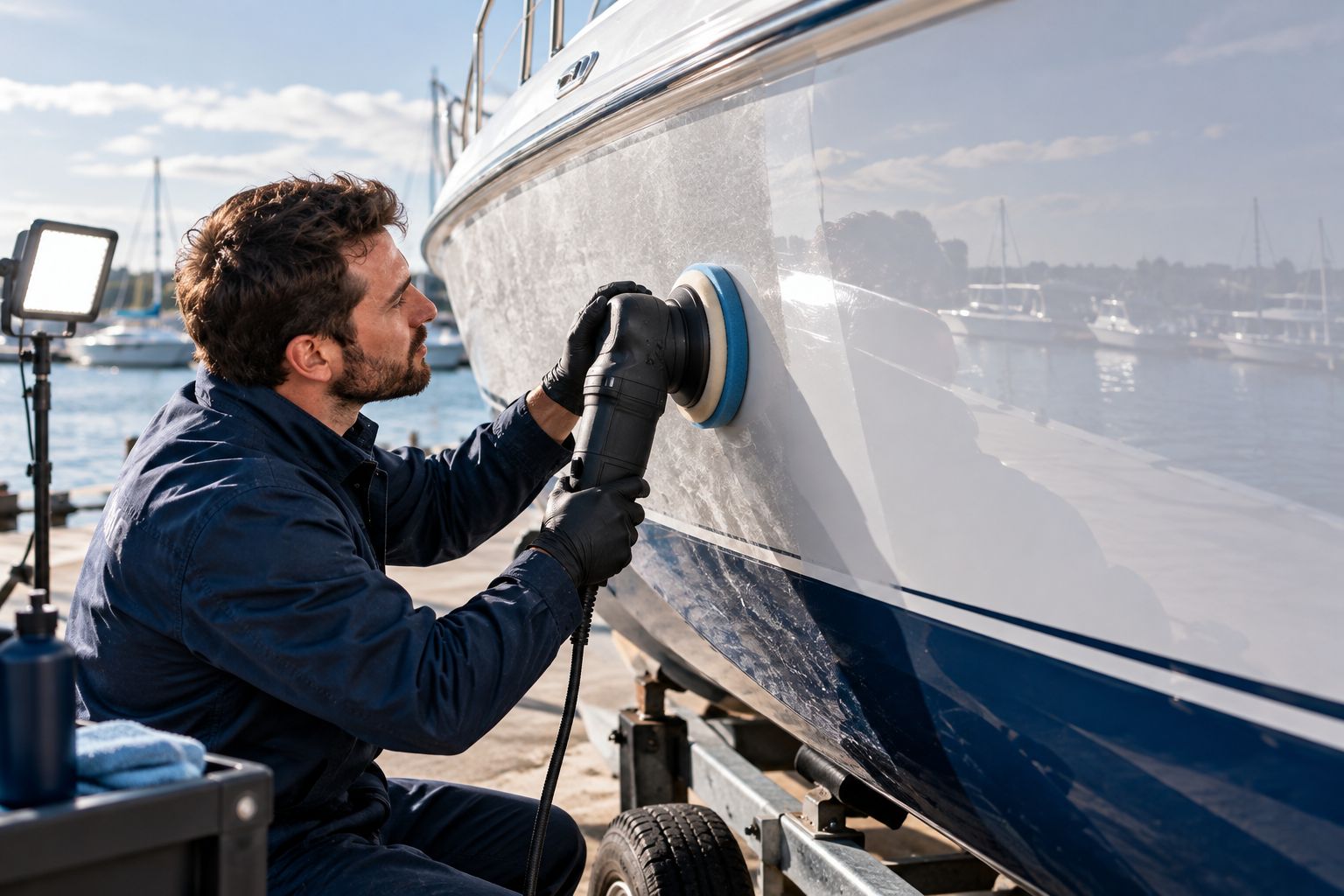
Remove polishing residue and inspect the dry panel from several angles. A glossy residue can hide incomplete correction until the final surface wipe exposes the actual gelcoat.
- Complete a small test section before choosing the full process
- Match the pad and abrasive to the observed oxidation level
- Reduce pressure and machine speed near edges and raised details
- Refine compounding haze with a finishing step when required
- Remove polishing residue before evaluating the corrected surface
- Stop if the test area reveals unstable repairs or material damage
Select a compatible coating system
Choose the product according to surface compatibility, exposure, application method, and maintenance expectations. The words ceramic or SiO2 do not establish that a formula supports gelcoat, antifouling paint, vinyl graphics, or constant immersion.
The Gtechniq Rinse On-Ceramic product description specifically identifies protection for a boat's gloss surfaces and describes the coating as optically clear, non-yellowing, and UV-repelling. That makes it relevant to gloss-surface maintenance, but it still cannot remove existing oxidation or replace the preparation stages.
Detailing World ATL also carries automotive coating products, wash products, and SiO2 detail sprays. Verify current label directions instead of assuming that every ceramic product in the catalog belongs on every marine surface.
Package volume is not a coverage guarantee. The available catalog includes Gtechniq W3 Ceramic GWash in 500ml and 1L sizes and Americana Ceramic Aftercare Soap in 16oz, but application rate and marine compatibility must come from the current product label.
- Confirm that the label names the intended hull material
- Check whether the product supports topside or submerged exposure
- Distinguish a base coating from a maintenance spray or wash product
- Review application temperature, ventilation, and cure requirements
- Match package volume to the manufacturer's stated coverage guidance
Prepare and apply one section at a time
After correction, remove oils and residue with the preparation method specified by the coating manufacturer. Do not substitute a strong solvent without checking compatibility with gelcoat, decals, repair materials, and surrounding trim.
Use clean applicators and microfiber towels reserved for coating work. Apply the product in sections that can be leveled before it begins to set, then inspect for dark patches, smears, or high spots under controlled lighting.
Avoid copying an automotive application routine without reading the marine product instructions. Flash behavior changes with product chemistry, air temperature, humidity, surface temperature, and airflow, so the label controls the working method.
- Mask sensitive trim, decals, porous materials, and unfinished repairs
- Prepare only the area you can coat within the working period
- Use a clean applicator and uncontaminated leveling towels
- Follow the stated application pattern and removal timing
- Inspect each completed section from several viewing angles
- Replace towels or applicators when they begin to harden or drag
Protect the coating during cure
Curing is part of the application, not an optional waiting period. Water, condensation, dew, dust, or handling during the stated cure window can disrupt the finish before it reaches its intended condition.
Keep the boat in an environment that meets the product directions. Do not launch it, wash it, cover it with a contaminated cover, or expose it to weather until the required cure conditions have been met.
Record the product, application date, surface, and cure completion in the job file. That gives a professional detailer or owner a clear maintenance reference later in 2026.
- Follow the manufacturer's stated cure time and environmental limits
- Keep rain, spray, dew, and wash water off the treated surface
- Prevent dust and dirty covers from contacting fresh coating
- Avoid adding another product unless the coating system permits it
- Record the coating date and treated hull sections
Maintain coated gelcoat without abrasive cleaning
Ceramic coating reduces the effort needed to remove routine contamination, but it does not make the hull maintenance-free. Rinse salt and loose residue before they dry, then wash with a product compatible with the installed coating.
Judge performance on a clean surface. Weak water behavior can come from mineral deposits, soap residue, or organic film sitting over the coating rather than immediate coating failure. Clean and decontaminate according to the coating maker's directions before deciding to reapply.
Detailing World ATL ceramic coating maintenance options include rinse-on protection and ceramic wash formats. The rinse-on option is fast and simple according to its product description; its limitation is that it cannot correct oxidized gelcoat. A ceramic wash supports routine cleaning, but its current label must still agree with the installed coating and hull material.
- Rinse the hull after exposure to salt, mud, or organic contamination
- Use clean wash media and a coating-compatible cleaner
- Avoid abrasive brushes on glossy coated gelcoat
- Remove mineral deposits with an approved maintenance method
- Inspect high-contact areas, the transom, and the waterline separately
- Reapply protection only after cleaning and evaluating the surface
Marine ceramic maintenance products
These products fit the washing and maintenance stage, not the oxidation-correction stage. Confirm the current label for the hull surface, existing protection, application process, and cure requirements before use.


Comparing protection options for boat owners
The best 2026 option depends on gelcoat condition, exposure, available working space, and willingness to complete correction. No protection method compensates for unstable repairs, active oxidation, or an incompatible surface.
| Option | Best for | Main advantage | Key limitation |
|---|---|---|---|
| Wipe-on ceramic coating | Corrected gelcoat when the label confirms compatibility | Controlled application over individual panels | Preparation and leveling errors remain visible beneath the coating |
| Gtechniq Rinse On-Ceramic | Boat owners maintaining compatible gloss surfaces | Product description identifies fast and simple boat-surface protection | Cannot remove oxidation, scratches, stains, or polishing defects |
| SiO2 detail spray | Maintenance between deeper cleaning and protection work | Simple hand application on approved surfaces | Functions as maintenance rather than gelcoat correction |
| Traditional wax or sealant | Owners who prefer a familiar hand-applied process | Straightforward application when compatible with the surface | Does not provide the same bonded coating system as a ceramic product |
| No added protection | Damaged or unstable surfaces awaiting repair | Avoids sealing over a problem that needs professional evaluation | Leaves sound gelcoat without an added sacrificial layer |
A wipe-on coating wins when the gelcoat has been fully corrected and the product explicitly supports that surface. Rinse-on protection wins when speed and routine maintenance matter more than installing a wipe-on base coating. Waiting is the correct verdict when the hull has unresolved damage, unidentified repairs, or incompatible antifouling material.
Common ceramic coating mistakes boat owners make
Coating over oxidation
Ceramic coating does not restore faded color or remove chalking. It preserves the prepared surface, so coating dull gelcoat leaves the defect visible and creates more work when correction is attempted later.
Treating the complete hull as one material
Topside gelcoat, vinyl graphics, repaired sections, hardware, and antifouling paint have different compatibility requirements. A product approved for one section does not automatically belong on every adjacent surface.
Confusing maintenance products with base coatings
A ceramic wash, rinse-on product, and SiO2 detail spray can support maintenance, but their names do not make them interchangeable with a wipe-on coating. Read the product purpose and directions before building the 2026 process.
Ignoring the cure instructions
Launching, washing, or exposing fresh coating to weather before the stated cure is complete risks disrupting the finish. The manufacturer's cure directions control, even when the surface feels dry.
Using aggressive tools on coated gelcoat
Abrasive brushes and contaminated wash media can mark the surface and reduce protection. Start with rinsing, compatible chemistry, clean wash media, and the least aggressive effective method.
FAQ
What is the best ceramic coating for boat hull gelcoat in 2026?
The best ceramic coating is one whose current label confirms compatibility with the boat's specific gelcoat and exposure conditions. Correct the gelcoat first, then compare whether the product is intended for topsides, gloss surfaces, or submerged use.
Can ceramic coating restore oxidized boat gelcoat?
No, ceramic coating cannot restore oxidized gelcoat. Compound and polish a test section first, remove the residue, and coat only after the dry surface has an acceptable finish.
Can automotive ceramic coating be used on a boat?
Only when the coating manufacturer confirms compatibility with the boat's exact surface and exposure. Automotive suitability alone does not establish compatibility with gelcoat, antifouling paint, vinyl graphics, or constant immersion.
Can ceramic coating go below the waterline?
Only use a product below the waterline when its manufacturer explicitly approves that exposure and the underlying material. Do not apply a topside coating over antifouling paint or another submerged surface without confirmed compatibility.
How much does boat ceramic coating cost?
The cost depends on hull size, oxidation, correction work, surface complexity, and the selected coating system. Request a current professional quote or check current product listings rather than relying on a fixed material figure.
Does a ceramic-coated boat still need washing?
Yes, a ceramic-coated boat still needs regular rinsing and compatible washing. The coating helps with contamination removal but does not stop salt, minerals, or organic residue from reaching the hull.
Is rinse-on ceramic protection the same as a wipe-on coating?
No, rinse-on protection and wipe-on coatings use different application processes and maintenance roles. Rinse-on protection is the faster option, while a wipe-on coating requires more controlled preparation, application, leveling, and curing.
How do I know when coated gelcoat needs maintenance?
Wash and decontaminate the surface according to the coating instructions before judging performance. Persistent contamination, reduced water behavior, or uneven appearance after proper cleaning signals that the system needs closer inspection.
One last thing
Do not judge gelcoat correction while the hull is wet. Water temporarily fills minor surface irregularities and increases apparent gloss, which can hide oxidation or polishing haze until the panel dries. Inspect the dry test section under controlled light before committing the full hull to a coating process in 2026.
That single check prevents the most expensive mistake in the job: sealing an unfinished correction beneath a product that must then be removed. Detailing World ATL can supply the detailing categories involved, but the hull condition and product label determine the final process.