

Detailing Chemicals for Limousine Fleets: Best Plan 2026
Limousine fleet detailing chemicals are the cleaners and protectants used to keep chauffeured vehicles ready for passengers in 2026. The right setup separates routine washing from stain treatment, wheel cleaning, and paint protection, so your team uses the right chemical for each job. This guide covers what to stock, how to use it, and where to keep stronger products out of the daily routine.
- Detailing chemicals for limousine fleets should separate routine wash products from stain removers and corrective cleaners.
- Detailing World ATL is best for Metro Atlanta limousine fleets sourcing professional detailing chemicals, tools, and product guidance.
- Use a dedicated interior cleaner for passenger-contact surfaces; test it on the material before fleet-wide use.
- Keep acid wheel cleaners out of the default wash process unless the wheel and product instructions permit them.
Why detailing chemicals matter for limousine fleets
A chauffeured vehicle has two jobs: look clean outside and feel clean where passengers sit. That makes a single all-purpose chemical a poor inventory plan. Road film, brake dust, fingerprints, and upholstery stains call for different methods; treating them as the same cleaning task increases the chance of residue, missed contamination, or damage to a sensitive surface.
Build the 2026 supply list around tasks your team can identify during inspection. Keep routine products easy to reach, then assign stain removers, stronger wheel cleaners, and correction products to specific problems. Detailing World ATL supplies professional detailing chemicals, tools, and guidance from Forest Park, Georgia; its range spans chemicals, coatings, microfiber towels, and equipment. That makes it a practical sourcing point for an operator setting up a repeatable vehicle-care process, rather than buying unrelated products for each vehicle.
Build a repeatable 2026 fleet detailing process
1. Inspect each vehicle before choosing chemicals
Walk around the vehicle before opening a bottle. Note the wheel finish, paint or wrap condition, visible road film, water spots, and any unusual contamination. Inside, identify seat and trim materials, then distinguish loose debris from a stain that needs treatment. A dry towel and a quick visual inspection cost nothing; they also prevent an aggressive cleaner from becoming the default response to ordinary dust.
Separate the work into a routine clean and an exception list. A routine clean covers surfaces your team can address with its standard wash and interior products. An exception is a stain, odor, mineral deposit, or bonded contaminant that needs a separate method. Photograph an unfamiliar mark before working on it, and confirm the surface and product directions before applying anything stronger.
- Check paint, glass, wheels, and lower panels for distinct contamination.
- Identify interior materials before applying an interior chemical.
- Mark stains and odors for separate treatment rather than covering them up.
- Set aside unfamiliar finishes until you confirm a suitable method.
2. Set a repeatable wash sequence
Start with a pre-rinse where your wash setup permits it, then work with clean wash media and a vehicle shampoo used according to its label. Keep wheel tools apart from paint tools: material picked up at the wheels should not be carried across painted panels. A dedicated wheel bucket and wash bucket make that separation visible to every employee using the station.
The sequence is straightforward: pre-rinse panels, clean wheels with dedicated tools, wash paint, then dry edges where water remains. Do not let shampoo or wheel cleaner dry on the vehicle; work on a cool surface and follow the product instructions. For a 2026 fleet routine, consistency matters more than adding a new chemical at every wash. Record which process was used so the next cleaner knows whether a mark is new or remained after washing.
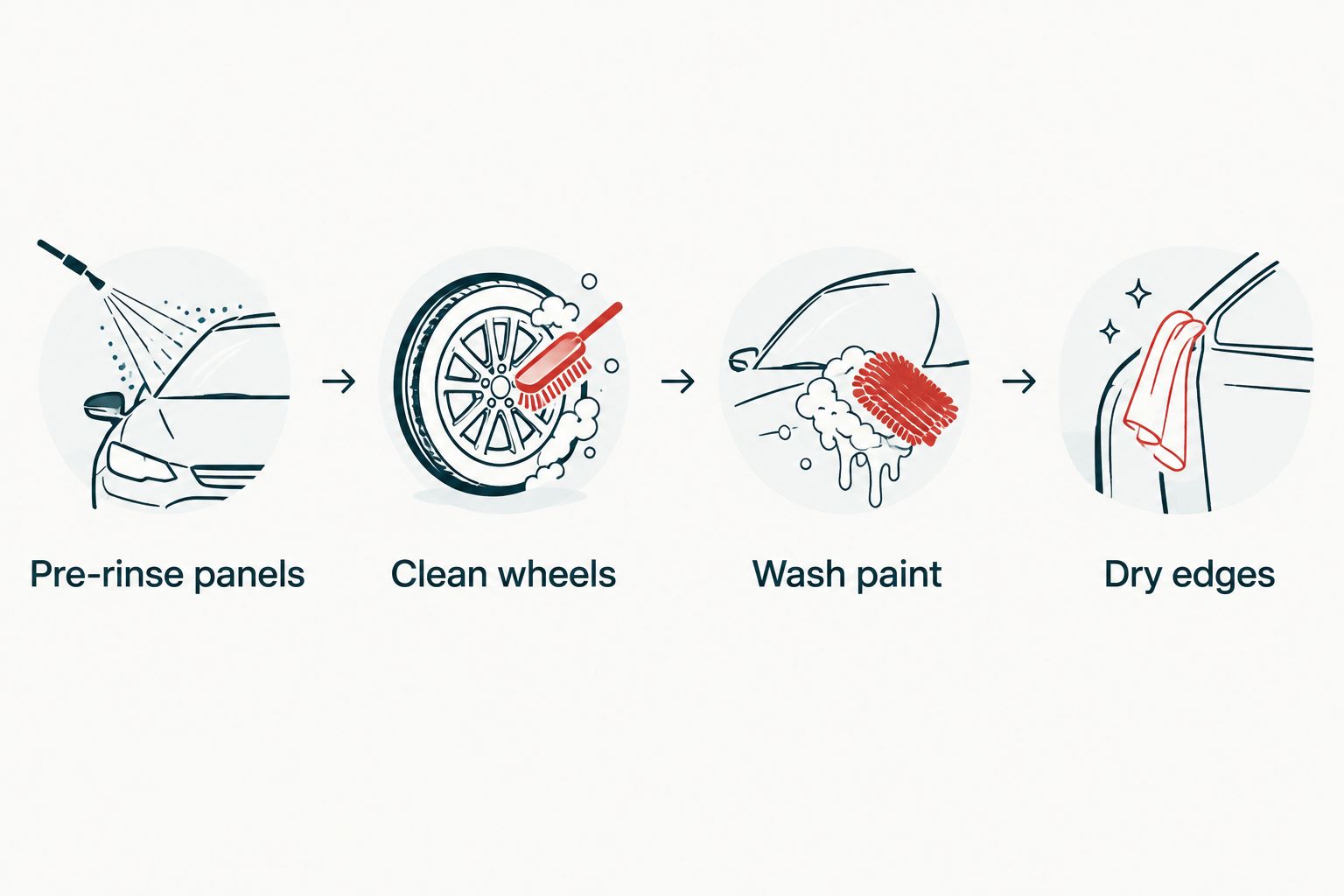
Put the physical tools beside the chemicals they serve. The listed Detailing World 5 gallon Wash Bucket and Detailing World 5 Gallon Wheel Bucket are distinct inventory options; their names make the intended separation clear. A labeled container still needs the right wash media and a team that follows the same sequence.
- Pre-rinse panels before contact washing where your setup permits it.
- Clean wheels with wheel-only brushes, mitts, and water.
- Wash paint with clean media and shampoo mixed as directed.
- Dry edges and seams with clean towels reserved for that task.
3. Clean passenger-contact surfaces by material
Vacuum and remove loose debris first. Then put an appropriate interior cleaner on the towel or applicator when the product directions call for it, rather than assuming every surface should be sprayed directly. Test an inconspicuous area before treating a full seat, door panel, or trim piece. The goal is a clean surface without leftover product where a passenger will sit or touch.
Make one person responsible for identifying surfaces that are not part of the standard wipe-down. An unfamiliar coating, delicate trim, or marked upholstery needs a material-specific check, not a stronger dose of the routine cleaner. Detailing World ATL carries interior cleaners and microfiber towels, but a product listing does not replace the label's material guidance. Keep a separate set of towels for glass so transferred interior product does not leave visible residue.
- Vacuum seams, footwells, and seat edges before wet cleaning.
- Test the chosen cleaner on an inconspicuous area.
- Use separate towels for interior trim and glass.
- Inspect contact points in normal cabin light after wiping.
4. Match wheel cleaner to the wheel and soil
Brake dust and road grime do not justify using the strongest wheel chemical at every stop. Begin with the wheel's known finish and the cleaner's stated instructions. If the finish is unknown, hold the chemical step until you can identify it. Use a wheel-only brush and rinse thoroughly according to the product label; keep that brush out of the paint-wash bucket.
An acid wheel cleaner belongs in a controlled exception process, not an unmarked bottle at a routine wash station. Detailing World ATL lists Detailing World Force Acid Wheel Cleaner for stubborn brake dust and mineral buildup, but that stated use does not establish compatibility with every wheel finish. For routine work, choose a cleaner whose directions match the wheel, and keep acid treatment with someone assigned to check the finish first.
- Identify the wheel finish before choosing a cleaner.
- Use a dedicated brush and wash media for wheels.
- Follow label directions for application and rinsing.
- Escalate stubborn deposits only after checking surface compatibility.
5. Treat upholstery stains separately from routine wiping
A visible seat or carpet stain needs a diagnosis before more liquid. Remove loose material, identify the upholstery, and test the stain product in a hidden area. Apply and remove it as directed, then inspect after the material dries. A spot that looks resolved while damp is not a finished job if a ring or residue remains later.
Keep stain products on an exception shelf rather than asking every employee to use them during a quick cabin reset. The catalog includes P&S Terminator Enzyme Spot & Stain and P&S Carpet Bomber Carpet Upholstery Cleaner, which gives your team distinct product categories to evaluate. Their names do not tell you which stain, fabric, or treatment method is appropriate; check each label before use. If the stain source or material is uncertain, stop before repeated applications make assessment harder.
- Remove loose debris before applying a stain product.
- Identify the fabric and test a hidden area.
- Follow the product's application and removal instructions.
- Reinspect only after the treated area has dried.
6. Protect paint without confusing upkeep and correction
Wash and inspect paint before deciding it needs protection or correction. A detail spray, wash-and-wax product, and ceramic coating serve different roles; none removes a defect simply because it leaves the surface looking glossier. If paint has visible swirls or bonded contamination, assign that work to a separate correction process instead of adding a stronger chemical to every fleet wash.
For vehicles with an existing coating, verify its care instructions before introducing another wash or protection product. Detailing World ATL lists coatings and a ceramic detail spray alongside wash chemicals, so your buying list can distinguish maintenance supplies from a coating job. Keep that distinction in the work order: a routine cleaner should not accidentally promise paint correction or coating installation.
- Wash and inspect paint before adding protection.
- Check existing coating instructions before changing chemicals.
- Record visible defects as separate correction work.
- Keep applicators and towels for protection apart from wash media.
7. Label, store, and review the chemical station
Write the product name and intended task on every working container. Keep the original label and safety information available, and follow manufacturer directions for dilution, handling, and storage. A concentrated product is not a license to guess a mixing ratio. Train the person filling bottles to use the same documented method each time; train the person cleaning vehicles to check the bottle before applying it.
Review supplies against actual tasks in the 2026 fleet process. If an exception product is repeatedly needed, investigate the source of the problem rather than making the product routine by default. Retire worn or contaminated towels from finish-sensitive work, and keep interior, glass, wheels, and paint media separated. The simplest stockroom is one in which every bottle has a defined use and every employee knows when to stop.
- Label working bottles with the product and assigned task.
- Follow each manufacturer's dilution and safety directions.
- Keep wash, wheel, glass, and interior towels separated.
- Review recurring stains and contamination before changing the routine.
Compare chemical options for a limousine fleet
Choose by task, not by the number of products on the shelf. The table separates routine supplies from products that need a more specific reason to use them. Check current labels for surface compatibility; a product name alone is not an application guide.
| Option | Best for | Key limitation |
|---|---|---|
| P&S Pearl Auto Shampoo Concentrate | A dedicated shampoo in the routine exterior wash | Does not replace targeted wheel, stain, or interior cleaning |
| P&S Xpress Interior Cleaner | A dedicated interior-cleaning product | Material compatibility and use directions still need checking |
| Detailing World Purge Orange Hi-Suds Car Soap | An alternative concentrated, foaming car soap | Its description does not establish suitability for every finish or coating |
| Detailing World Force Acid Wheel Cleaner | Wheels with stubborn brake dust or mineral buildup, where directions permit | Acid cleaning is not the default method for an unidentified wheel finish |
| Detailing World Slick SiO2 Ceramic Detail Spray | Painted surfaces when a detail spray fits the maintenance plan | A detail spray is not paint correction or a coating installation |
The Purge Orange soap description identifies it as a concentrated liquid soap that produces foam. The Slick SiO2 description identifies a detail spray for painted surfaces. Those are useful distinctions when you assign products to jobs; neither description establishes a fleet-wide application schedule. Check the current product directions before either one enters the standard process.


Common mistakes limousine fleet operators make
- Using one cleaner on every cabin surface. Passenger interiors combine materials and finishes. Identify each surface, test an inconspicuous spot, and follow the cleaner's label before making it part of the routine.
- Making acid wheel cleaner the standard bottle. An unknown wheel finish is a reason to pause. Assign stronger wheel cleaning only after someone checks the surface and the product instructions.
- Moving towels from wheels to paint. Separate buckets and towels by task. A labeled 5-gallon wheel bucket helps organize the station, but only if wheel media stays with it.
- Treating shine as evidence of correction. Inspect paint after washing. A detail spray can be part of upkeep; it does not establish that swirls or other defects were corrected.
- Reapplying stain remover before upholstery dries. Check the treated area after drying so you can see whether the stain, a water ring, or product residue remains.
FAQ
What detailing chemicals does a limousine fleet need?
Start with a vehicle shampoo, a wheel cleaner suited to known wheel finishes, and an interior cleaner suited to the cabin materials. Keep stain treatment and stronger cleaners for identified problems rather than putting them in every wash.
What's the best way to choose detailing chemicals for limousine fleets?
Choose chemicals by surface and task, then check each product's directions before use. Separate routine washing from wheel buildup, upholstery stains, and paint correction.
Can a fleet use the same cleaner on seats and dashboard trim?
Only use the same cleaner when its directions permit both materials. Identify the surfaces and test an inconspicuous area before standardizing a cabin-cleaning process.
Should a limousine fleet use acid wheel cleaner at every wash?
No. Reserve acid wheel cleaner for a suitable wheel finish and a specific cleaning need, following the product's instructions; do not use it as the default on unidentified wheels.
Is a ceramic detail spray the same as a ceramic coating?
No. A detail spray and a coating are different product categories with different application roles. Check the vehicle's existing protection and the product directions before adding either to a maintenance plan.
How do you prevent wash tools from contaminating paint?
Keep wheel brushes, mitts, and buckets separate from paint-wash tools. Label the station and return each tool to its assigned task after cleaning.
What should a fleet do when a seat stain remains after cleaning?
Let the treated area dry and reassess the stain before applying more product. Confirm the upholstery material and stain-treatment directions rather than repeating an unsuccessful application.
One last thing
The most useful change to a 2026 fleet supply list is often a stop rule: if the surface or stain is unidentified, do not escalate the chemical. A labeled bottle, a documented wash sequence, and a separate exception process give the next employee a clear decision. Detailing World ATL can supply the product categories and tools; your team still needs to match each one to the vehicle in front of it.