

Best Detailing Products for EV Brake Dust in 2026
EV owners with regenerative brake dust face a cleaning problem that runs backward from what most detailing guides assume: less brake dust overall, but the dust that does form gets more time to bake onto the wheel face before a wash knocks it loose. The detailing products for EV brake dust that actually work target bonded iron contamination directly, not the weekly friction-and-rinse habit built for a gas car.
- P&S Brake Buster dissolves baked-on iron dust on EV wheels without acid-etching clear coat finishes.
- Detailing World Force Acid Wheel Cleaner cuts heavy, months-old buildup fast, but needs a coating-safe option on painted wheels.
- CarPro DLux Plastic & Wheel Protective Coating slows how fast brake dust bonds between an EV's less frequent washes.
- Front wheels carry more braking load than rear wheels on most EVs even with regen blending — clean them first.
Why detailing products for EV brake dust matter
Regenerative braking recovers most of the deceleration energy in stop-and-go driving, so the friction pads and calipers on an EV engage far less than they would on a comparable gas vehicle covering the same miles. That's good for pad life. It's not automatically good for the wheel face.
Less friction use means less dust gets knocked loose by heat cycling and vibration between washes. What sticks tends to stay put longer, oxidize, and bond into the finish before it ever meets a brush. A wheel cleaner picked for a gas car's weekly dust load can under-perform on an EV's less frequent, more stubborn buildup — or an owner reaches for the strongest acid on the shelf and etches a finish that never needed it.
Detailing World ATL stocks wheel chemistry built around dwell time and finish compatibility, not brute acid strength — that's the difference that matters on an EV wheel in 2026.
Build a wheel routine for regenerative braking
Identify your wheel finish before you buy anything
A product that's safe on bare aluminum can etch a painted finish in minutes. Know what you're cleaning first.
- Bare or polished aluminum
- Clear-coated cast or forged alloy
- Painted multi-spoke wheels, common on higher EV trims
- Plastic aero wheel covers over steel wheels, common on lower-trim EVs
- Chrome or chrome-plated accents
Test any new cleaner on a hidden section — a lug nut recess or inner barrel — before running it across the whole wheel.
Dissolve bonded iron dust before you scrub
Scrubbing first just grinds baked-on iron particles into the clear coat. Dwell time does the work a brush shouldn't have to.
- Spray an iron remover on a cool, shaded wheel — never in direct sun
- Let it dwell per the label before any agitation
- Work front wheels first; they carry more braking load than the rear even with regen blending tuned across all four corners
- Rinse from the top of the wheel down, not the barrel up
- Check the parking brake caliper separately — it sees the least friction use on an EV and can hold dust that never gets scrubbed off by pad wear
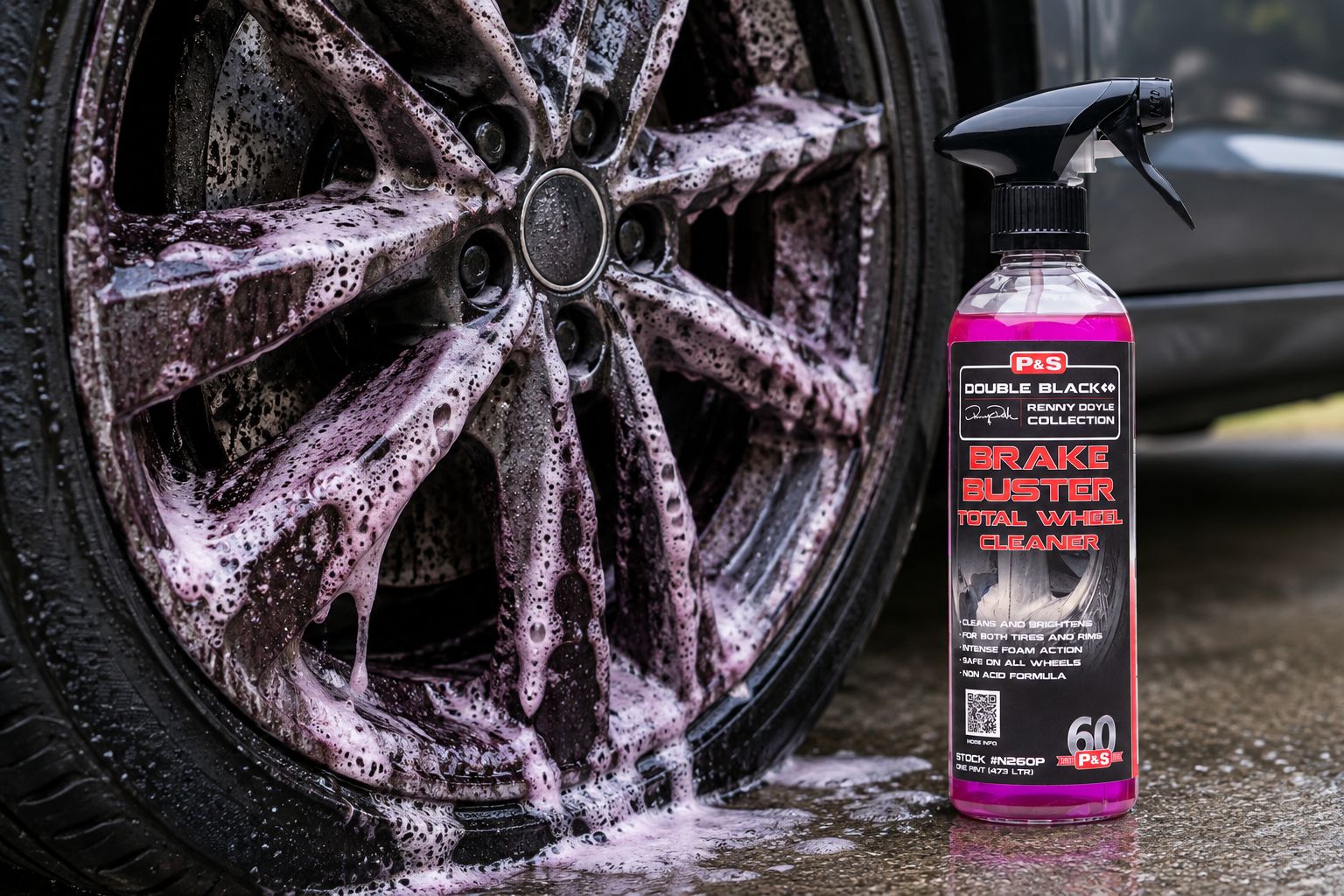
P&S Brake Buster is built for this stage. It's formulated to break down brake dust, oil, and light corrosion on premium wheel finishes without cutting into clear coat, which matters more on a wheel that's only getting scrubbed once or twice a month instead of every week.
Choose the right wheel cleaner for how often you actually wash
Heavy, months-old buildup on bare or clear-coated wheels calls for a stronger formula than a wheel that gets attention every two weeks.
- Bare or clear-coated wheels with heavy, aged buildup: an acid-based cleaner cuts fast
- Painted wheels or anything with an existing coating: a pH-balanced formula protects the finish
- Wash intervals longer than two weeks: favor longer dwell time over a fast acid hit that still leaves residue
- After any acid wheel cleaner: a full rinse and a second look for missed dust, not just a hose-off
Detailing World Force Acid Wheel Cleaner cuts through stubborn brake dust and mineral buildup fast on wheels that have gone weeks without a wash, but for painted or wrapped wheels, reach for a less aggressive cleaner.
Agitate wheel faces without marring the finish
- Use a dedicated wheel brush, never the mitt that touches paint
- Work in straight lines along the spokes, not circles
- Rinse the brush in a bucket separate from the wash bucket
- Skip stiff nylon brushes on plastic aero covers — they scratch faster than cast alloy


Rinse and dry before water spots set
- Rinse top-down, wheels last
- Use a drying towel dedicated to wheels, separate from paint towels
- Dry within a few minutes in direct sun to avoid mineral deposits from tap water
- Blow out lug nut recesses and valve stems with compressed air or a mini dryer if one's on hand
Coat the wheel face to slow how fast dust bonds
A bare or unsealed wheel gives brake dust nothing to slide off of. A coated wheel gives it far less to grip.
- Confirm the wheel is fully decontaminated and dry before coating — coating over existing dust locks it in
- Apply in thin, even passes and let it cure per label directions before the wheel gets wet again
- Reapply on a schedule tied to mileage and wash frequency, not a calendar guess
CarPro DLux Plastic Wheel Protective Coating is built for exactly this: a sealed wheel face that sheds the dust regen braking still produces instead of letting it sit and bake for weeks between washes.
Set a wash interval that matches your driving, not a gas-car habit
- Mostly stop-and-go city driving: dust accumulates slower than a gas car but still needs a wheel-only check every 1-2 weeks
- Mostly highway miles: friction brakes engage even less; stretch the wheel wash interval but check the parking brake caliper for surface rust monthly
- Mixed driving: default to a 2-week wheel check regardless of the overall car wash schedule
Comparison: wheel products for EV brake dust
| Option | Best for | Key limitation |
|---|---|---|
| P&S Brake Buster | Baked-on iron dust on EV wheels washed every 2+ weeks | Needs a full rinse before drying to avoid residue film |
| Detailing World Force Acid Wheel Cleaner | Heavy, months-old brake dust buildup | Acid formula needs a coating-safe follow-up on painted wheels |
| CarPro DLux Plastic Wheel Protective Coating | Wheels that need less frequent aggressive cleaning long-term | Requires a fully decontaminated, dry surface to bond correctly |
Verdict: for most EV owners in 2026, run P&S Brake Buster on a two-week cycle and add CarPro DLux once the wheel is fully decontaminated — save the acid cleaner for buildup that's gone unwashed for a month or more.
Common mistakes EV owners make with brake dust
- Skipping washes because "EVs don't make brake dust" — regen braking reduces dust, it doesn't eliminate it, and what forms sits and bonds longer
- Reaching for the strongest acid cleaner first on aero wheel covers or painted multi-spoke wheels, causing etching that a pH-balanced formula would have avoided
- Ignoring the parking brake caliper and rear rotor face, which see the least friction use on an EV and can develop light surface rust between washes
- Skipping a wheel coating and repeating heavy acid cleanings every wash, which shortens clear coat life faster than the coating-and-maintain approach
- Using the same wash mitt on wheels and paint, cross-contaminating iron particles onto body panels
“Regenerative braking doesn't eliminate brake dust — it just gives it more time to bond before you wash it off.”
FAQ
What's the best detailing product for EV brake dust in 2026?
P&S Brake Buster is the best starting point for most EV owners in 2026 because it dissolves bonded iron dust without acid-etching clear coat or painted wheel finishes. Reach for a stronger acid cleaner only on wheels that have gone a month or more without a wash.
Do electric vehicles still get brake dust?
Yes. Regenerative braking reduces how often friction pads engage, which cuts total dust output, but it doesn't eliminate it. The dust that does form has more time to bond before a wash removes it.
Is acid wheel cleaner safe for EV alloy wheels?
Acid wheel cleaners like Detailing World Force Acid Wheel Cleaner work fast on bare or clear-coated alloy wheels but need a coating-safe rinse routine on painted or wrapped finishes. Test on a hidden section first.
How often should EV owners wash their wheels?
Every 1-2 weeks for mostly city driving, and roughly monthly checks for mostly highway driving. Regen braking slows dust buildup, but it doesn't stop the parking brake caliper from developing surface rust between washes.
Can a wheel coating stop brake dust from sticking?
A wheel coating like CarPro DLux Plastic Wheel Protective Coating doesn't stop dust from forming, but it gives dust less surface to bond to, so washes require less aggressive scrubbing over time.
Why does brake dust look worse on EVs that barely use the brakes?
Less friction use means less vibration and heat cycling to knock dust loose between washes. What sticks oxidizes and bonds in place, so a small amount of dust can look more stubborn than a larger amount on a frequently-braked gas car.
What tools do I need besides wheel cleaner?
A dedicated wheel brush kept separate from paint mitts, a wheel-only drying towel, and a separate rinse bucket for the brush. Cross-using paint tools on wheels spreads iron particles onto body panels.
Should front and rear wheels get the same treatment?
Front wheels typically carry more braking force than rear wheels even with regen blending, so they usually need the iron remover and coating attention first, with rear wheels following at the next wash.
One last thing
Front wheels on most EVs still absorb more braking force than the rear even with regen blending tuned across all four corners in 2026 model-year vehicles. Treat the front wheel face as the one that needs the iron remover and coating first, then extend the same steps to the rear at your next wash instead of treating all four wheels identically.
Related guides
- Best wheel cleaner for brake dust on daily-driven cars
- Wheel ceramic coatings for long-term brake dust resistance