

Detailing Products for Luxury Car Concierge in 2026
Luxury car concierge detailing products are the chemicals, coatings, and tools concierge teams use to keep high-end vehicles show-ready between full details, with the aim of turning a car around in minutes without leaving water spots, residue, or streaks a valet guest would notice. Concierge work is not a two-hour detail bay job — it happens in hotel garages, private driveways, and dealership lots where a hose is often nowhere in sight, and the vehicle in front of you might be a client's own car worth six figures.
- Detailing products for luxury car concierge work need to be fast, waterless-capable, and coating-safe — not just premium-branded.
- Rinseless wash concentrates and ceramic spray toppers replace full wash-and-wax routines when there's no hose access.
- Gtechniq Crystal Serum Light and Gyeon Q2 Syncro Evo cover the cured-coating end for fleets needing months of protection between services.
- Standardizing one microfiber towel line across every technician cuts the swirl complaints concierge services get most often.
Why detailing products matter for luxury car concierge services
A concierge client isn't paying for a wash — they're paying for a car that looks untouched by the trip it just took. That standard is unforgiving: a streak on a black paint job or a lingering vanilla air freshener smell reads as sloppy on a $150,000 vehicle in a way it never would on a daily driver.
Detailing World ATL stocks the category of products concierge teams actually reach for on a rotation — rinseless washes, quick detailers, coating toppers, and towel systems built to be repeated dozens of times a week without degrading finish quality. The gap between a hobbyist detailing kit and a concierge-grade lineup shows up fastest on wheels, glass, and interior trim, the three spots a guest checks first when they get back in the car.
Build a rinseless wash kit for locations without hose access
Most concierge stops — hotel porte-cochères, office garages, private residences with HOA water restrictions — don't allow a hose and bucket setup. The manual fallback is a rinseless or waterless wash concentrate diluted into a spray bottle or pump sprayer, worked in sections with a plush wash mitt and buffed dry before it flashes.
- Mix rinseless concentrate at the ratio printed on the label — over-diluting is the top cause of marring on this method
- Work one panel at a time in straight lines, never circular scrubbing
- Fold the microfiber to a clean face every two to three panels
- Keep a second dry towel dedicated only to buffing, never wiping
- Test the method on a lower door panel before running it on hood or trunk paint
Stock a fast, ceramic-safe interior quick detailer
Interior turnaround is where concierge jobs live or die on time. A one-step interior quick detailer that's rated ceramic-safe lets a technician wipe down dash, console, and door panels without stripping a coating the vehicle already carries.
- Spray onto the towel, not the surface, to avoid overspray on vents and screens
- Use a separate towel color for interior versus exterior work to prevent cross-contamination
- Check compatibility with leather before using on stitched seats — some formulas leave a film on porous leather
- Wipe glass and trim last so any residue doesn't transfer to freshly cleaned surfaces
Top up ceramic coatings between full correction jobs
Most concierge fleets already carry a cured ceramic coating from a prior detail. The concierge role isn't reapplying that coating — it's extending it with a spray topper between full services. Gtechniq Crystal Serum Light is a cured coating option for vehicles due for a full reapplication rather than a quick top-up, and it needs proper paint prep and cure time before the car goes back on the road — not a same-day fix. A spray-on SiO2 topper, by contrast, adds gloss and slickness in minutes and works as the day-to-day maintenance layer.
Clean wheels without stripping factory or aftermarket finishes
Luxury fleets run a wider mix of wheel finishes than a typical detail shop sees in a month — powder coat, PVD, gloss black, exposed carbon. An acid-based wheel cleaner strips protective clear coats on several of these finishes over repeat visits, which is a slow way to lose a client's trust.
- Confirm the wheel finish before spraying anything acidic
- Default to a pH-neutral or acid-free wheel cleaner on any coated or aftermarket rim
- Agitate brake dust with a soft wheel brush instead of relying on chemical dwell time alone
- Rinse or wipe fully before the cleaner dries on the surface
- Finish with a wheel-specific ceramic coating on fleet vehicles that get cleaned weekly, to cut future dwell time
Standardize microfiber towels across every vehicle
Swirl marks and lint transfer almost always trace back to towel mismanagement, not the chemical used. A dual-plush towel like a Korean Plush 350 GSM microfiber towel holds up to repeat laundering far better than a low-pile drying towel, which matters when one towel gets used on 15 to 20 cars a week.
- Color-code towels by task: exterior, interior, glass, wheels — never cross-use
- Wash microfiber separately from cotton to avoid lint transfer
- Retire towels once the pile flattens or edges fray
- Skip fabric softener, which coats the fibers and reduces absorbency
Refresh cabin air without masking odors
A heavy air freshener spray is the fastest way to make a luxury interior smell like a rental car. Concierge teams need an actual odor eliminator, not a fragrance layer sitting on top of the smell.
- Identify the odor source (smoke, pet, food) before choosing a treatment
- Use an odor eliminator rated for the specific contaminant, not a generic air freshener
- Treat fabric and carpet, not just the air, since odor sits in the fibers
- Ventilate the cabin for several minutes after treatment before closing it back up
Train every technician on the same dressing routine
Different hands using different dressing amounts on trim and tires is the most common reason two cars from the same fleet look inconsistent parked side by side.
- Standardize on one interior and one tire dressing product across the whole team
- Apply dressing with an applicator pad, never straight from the bottle
- Wipe excess before it pools in trim seams or wheel wells
- Match satin or gloss finish level to the vehicle owner's stated preference, not a default setting
“If a guest can see the swirl before you can, the concierge job isn't finished.”
Comparing detailing product options for concierge work
| Option | Best for | Key strength | Key limitation |
|---|---|---|---|
| Rinseless/waterless wash | Garages, valet stands, HOA-restricted lots | No runoff, no hose needed | Not enough dwell time for heavy road grime |
| Ceramic spray topper | Quick gloss touch-ups between full applications | Applies and buffs off in minutes | Shorter durability than a cured coating |
| Cured ceramic coating (Gtechniq Crystal Serum Light, Gyeon Q2 Syncro Evo) | Fleet vehicles needing months of protection | Long dwell before reapplication is due | Needs paint prep and cure time, not same-day |
| Ready-to-use interior quick detailer | Cabin refresh between guest handoffs | One-step clean and shine | Won't lift set-in stains |


Common mistakes luxury car concierge services make
- Using acid wheel cleaners on coated or aftermarket rims — luxury fleets run more powder-coat and PVD finishes than average, and acid cleaners dull them over repeat visits.
- Treating water restrictions as a reason to skip protection instead of switching to rinseless washes or spray toppers built for that exact situation.
- Letting technicians rotate towels across tasks, so paint on one car ends up marred by grit picked up wiping wheels on the last one.
- Skipping wheel and tire prep before a coating topper, so the topper doesn't bond and washes off after one rain.
- Masking cabin odor instead of eliminating it — a heavy fragrance layer over a real odor is obvious to a guest within seconds of getting in.
FAQ
What detailing products does a luxury car concierge service need to start in 2026?
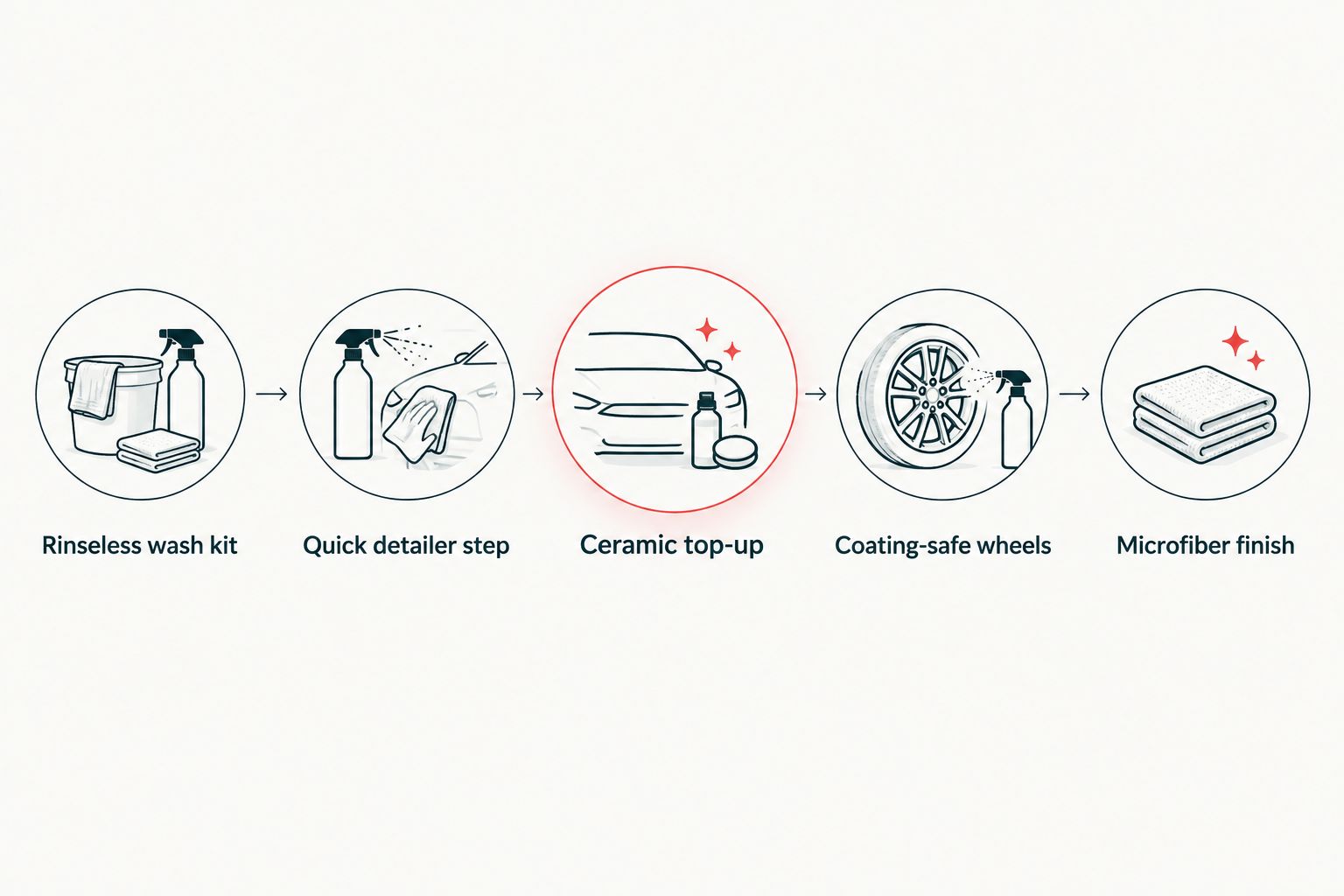
A concierge kit needs a rinseless or waterless wash concentrate, a ceramic-safe interior quick detailer, a ceramic spray topper, a coating-safe wheel cleaner, and dedicated microfiber towels for each task. This covers the majority of turnaround stops where a full detail bay isn't available.
Is ceramic coating necessary for concierge vehicles?
A cured ceramic coating like Gtechniq Crystal Serum Light isn't required for every stop, but it cuts the time spent on gloss and protection maintenance between visits. Vehicles without one rely more heavily on spray toppers, which need reapplication far more often.
What's the best quick detailer for a fast concierge turnaround?
A ceramic-safe interior quick detailer that cleans, shines, and protects in one step is the standard pick for turnaround work, since it removes the need for a separate cleaning and dressing pass. Look for a non-greasy, low-residue formula so it doesn't leave a film under bright hotel lighting.
Can a concierge team detail cars without hose access in a parking garage?
Yes — a rinseless wash concentrate worked with a plush wash mitt and buffed dry with microfiber covers most garage and valet-stand situations. It won't replace a full wash on heavily soiled vehicles, but it handles routine surface dust and light grime.
How often should a ceramic-coated luxury car get a spray topper?
Spray toppers are typically applied every few weeks on high-use fleet or concierge vehicles to maintain gloss and beading between the cured coating's full reapplication cycle. Frequency depends on wash schedule and how much the vehicle is driven in the interim.
What wheel cleaner is safe for aftermarket rims on luxury vehicles?
A pH-neutral or acid-free wheel cleaner is the safer default for powder-coated, PVD, or ceramic-coated wheels common on luxury fleets. Acid-based cleaners work faster on brake dust but carry a higher risk of stripping those finishes over repeated use.
Do concierge teams need different products for leather versus synthetic interiors?
Yes — porous leather can absorb residue from a generic interior spray that a synthetic surface simply wipes clean. Check a product's leather compatibility before using it on stitched or perforated seats to avoid a filmy or sticky finish.
One last thing
Concierge fleets with wrapped or PPF-covered panels are becoming more common in 2026, and standard interior dressings and ceramic toppers aren't formulated for film surfaces — a flexible film coating like Gtechniq Halo is built specifically for that panel type, which most detail kits still overlook. If your route includes even one wrapped vehicle, it needs a separate product line, not a shared one.