

Detailing Supplies for Auto Auction Prep Companies (2026)
Detailing supplies for auto auction prep companies means one thing in 2026: chemistry and equipment built for volume, not for a single showroom car. A prep line running 40 to 150 vehicles a week through consignment lanes needs a different supply stack than a mobile detailer doing one Tesla a day — dilution control, odor elimination, and wheel turnaround matter more than show-car gloss.
- Detailing supplies for auto auction prep in 2026 center on concentrate wash, acid wheel cleaner, and odor treatment, not full-detail chemicals.
- P&S Pearl Auto Shampoo Concentrate cuts cost per vehicle on high-volume wash lines. Buy for daily fleet washing.
- Detailing World Force Acid Wheel Cleaner strips brake dust fast but needs dwell-time discipline on clear-coated wheels.
- A ClO2 odor eliminator treats smoke and pet odor before a vehicle reaches the auction lane, not after.
- Measuring dilution ratios instead of eyeballing them is what separates a profitable prep line from an expensive one.
Why detailing supplies matter for auto auction prep
Auction condition reports grade paint, wheels, and interior odor separately, and a low grade on any one of those categories drags down the sale price regardless of the mechanical condition. Auto auction prep companies don't get paid for a paint correction — they get paid for throughput, so the supply stack has to hold up wash after wash without babysitting.
That changes what "good" detailing supplies look like for this segment. A concentrate that dilutes wrong on vehicle 30 of the day costs more in wasted chemical and re-wash time than a slightly pricier bottle that holds its ratio. Detailing World ATL stocks its auction-facing lineup around exactly that constraint: concentrates that scale, acid cleaners that cut brake dust fast, and odor chemistry strong enough for a smoke-damaged trade-in.
Wash the fleet with a concentrate, not bottled RTU
Running ready-to-use spray bottles across 40+ vehicles a day burns through product and cash. A pint of concentrate diluted correctly can outlast a case of RTU bottles, and the wash chemistry stays consistent from the first car to the last.
P&S Pearl Auto Shampoo Concentrate is built for this — a pH-balanced formula that dilutes down for daily washing without stripping whatever sealant or wax the previous owner left on.
- Mix a daily-wash ratio and a heavier deep-wash ratio, and label both buckets so nobody eyeballs it
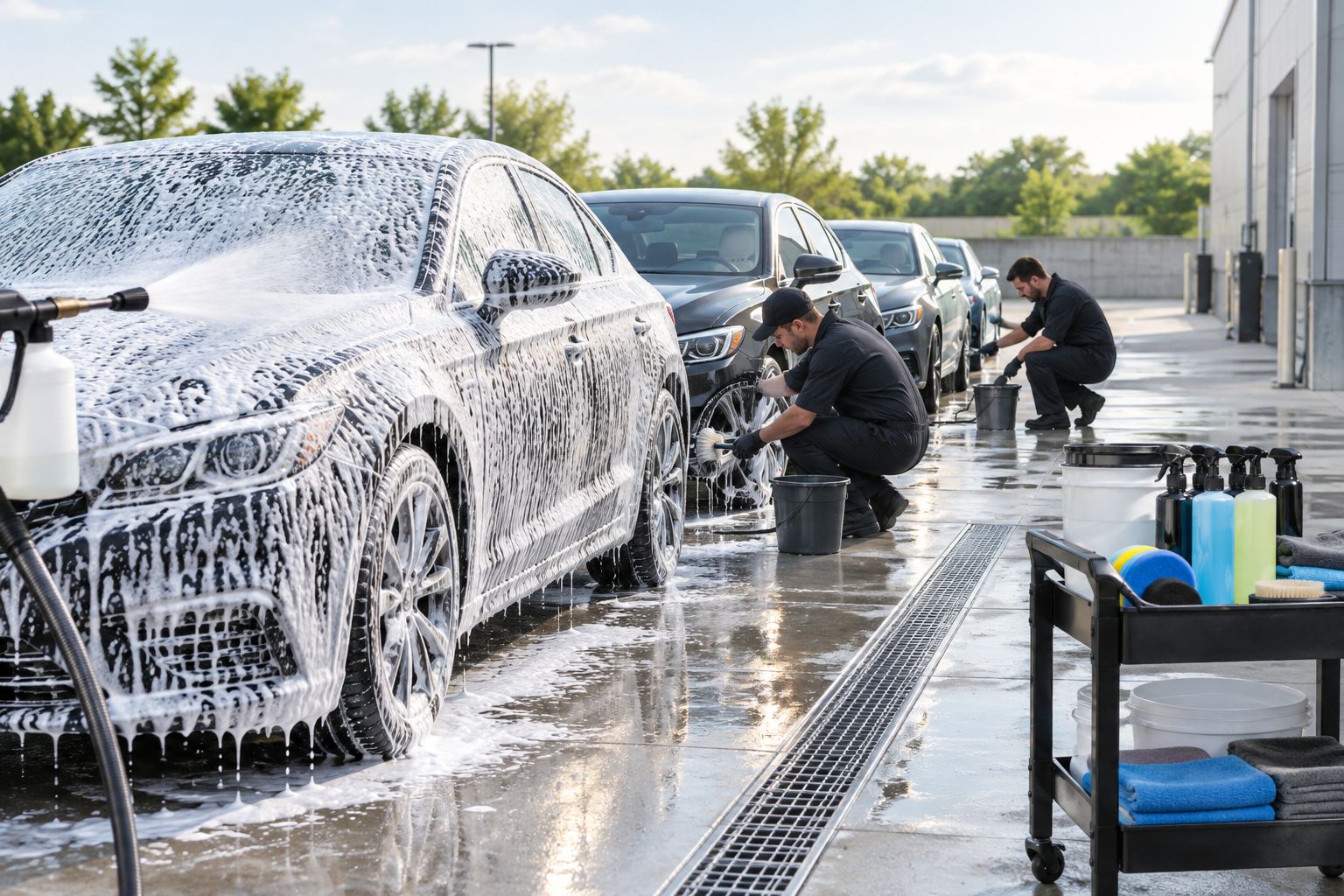
- Run a foam sprayer ahead of the wash mitt to lift loose dirt before contact, cutting swirl risk on painted trade-ins
- Use the two-bucket method — wash solution and rinse water separate — even on a fast line, or every car after the third one picks up marring
- Wash lighter, cleaner vehicles first in the queue to stretch the same batch of solution further
- Check the bucket's suds level at the midpoint of the shift and top off before it goes flat
Strip wheels and brake dust fast without staining them
Brake dust is baked onto most trade-in and fleet wheels by the time they hit an auction prep line, and a neutral wheel cleaner won't touch it fast enough to keep pace. Detailing World Force Acid Wheel Cleaner cuts through heavy brake dust in one pass, but acid formulas demand dwell-time discipline on clear-coated wheels or they etch.
- Set a hard dwell-time limit and don't let the cleaner sit past it while the crew moves to the next car
- Test on one wheel of an unfamiliar fleet batch before running acid cleaner across the whole lot
- Keep a separate bucket and brush for wheels — cross-contamination with the body wash bucket causes rail marks
- Rinse thoroughly before the product dries onto the barrel, especially in Georgia summer heat
- Use a soft wheel brush on factory clear-coat and reserve stiff barrel brushes for uncoated commercial wheels
Dial in dilution ratios before scaling volume
Most of the margin lost on a high-volume prep line disappears in mis-diluted chemical, not in labor. A shop that eyeballs ratios instead of measuring them either wastes concentrate or under-dilutes and streaks paint under auction lane lighting — both cost more than the five minutes it takes to set up a dilution chart.
Dilution ratios for concentrated detailing chemicals should be posted at every mixing station, not stored in someone's memory.
- Label every spray bottle and bucket with the exact ratio, not just the product name
- Batch-mix a day's supply in 5-gallon containers instead of remixing bottle by bottle
- Calibrate foam sprayers and pump sprayers monthly — nozzle wear changes the actual output ratio over time
- Track cost per vehicle from the concentrate ratio so pricing reflects real chemical spend, not a guess
- Rotate mixing duty to one trained person per shift instead of letting every detailer mix their own
Neutralize odor before the vehicle reaches the lane
Smoke, pet, and food odor lower a condition report grade independently of how clean the interior looks, and masking it with air freshener doesn't survive a buyer's test drive. A ClO2-based odor eliminator like DeodorPro ClO2 Odor Eliminator breaks down odor molecules instead of covering them.
- Run odor treatment before the interior wipe-down, not after — treating a freshly cleaned cabin traps residual odor under new product smell
- Treat the HVAC system, not just cabin air, since recirculated odor comes back through the vents within a day
- Give heavy smoke vehicles an enclosed treatment period overnight rather than a five-minute spray-and-go
- Pair odor treatment with an enzyme spotter on the source stain — fabric and leather need different protocols
- Re-check odor the next morning before consignment; some treatments read clean at first and rebound after the cabin closes back up
Protect trim, glass, and tires for lot presentation
Auction lanes run vehicles under bright, unforgiving lighting, and dull trim or a streaked windshield reads as neglect even on a mechanically sound car. Tire dressing matters here more than most detailers assume — a water-based dressing holds up better outdoors overnight than an oil-based gloss that attracts dust and looks worse by morning.
- Use a streak-free glass cleaner on a microfiber towel for the final pass, since lane inspectors get close to the windshield
- Dress tires with a water-based formula rather than a heavy oil-based gloss on vehicles sitting outdoors before sale
- Apply a quick spray sealant on painted trim instead of a full wax cycle — it's faster and holds enough shine for the lane
- Skip greasy dressings on plastic trim in outdoor lots; they collect road dust within hours and need a second pass
Organize the prep line for consistent throughput
A prep line only moves as fast as its slowest station, and most bottlenecks come from disorganized carts and shared tools, not from the chemistry itself.
- Dedicate a rolling cart per station — wash, wheels, interior — so nobody walks across the lot for a bottle
- Label buckets by task (wash, rinse, wheel) so nobody grabs the wrong one mid-shift
- Schedule washer-to-detailer-to-wheel ratios based on actual daily volume instead of a fixed crew size
- Restock consumables at shift start, not mid-shift, so a low-suds bucket doesn't stall the line
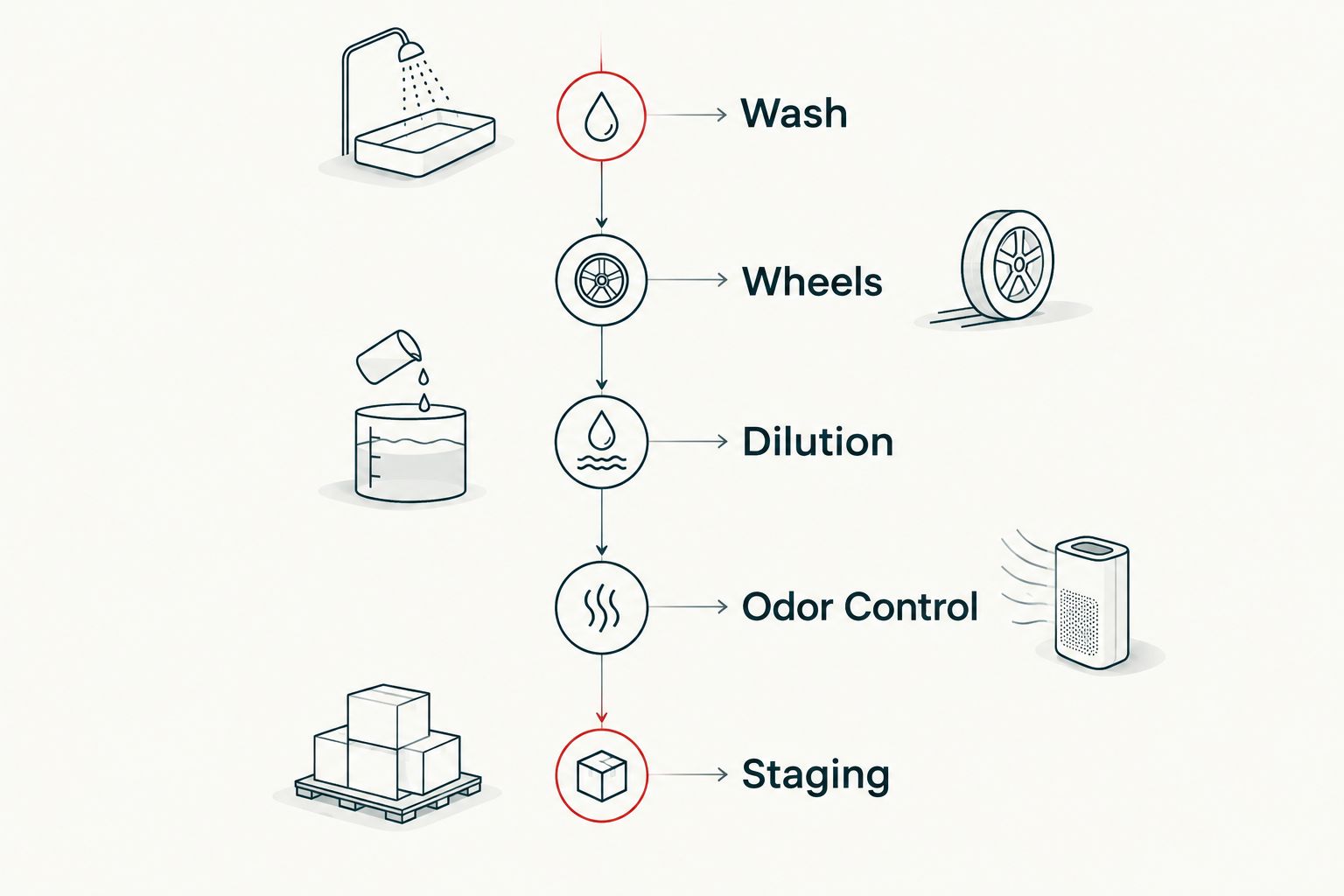
A disorganized cart is the most common reason a fast prep line slows down mid-shift, even when the crew and chemistry are both solid.


Wash format options for auction prep lines
| Option | Best for | Key limitation |
|---|---|---|
| Concentrate wash system | Fixed wash bay running 40+ vehicles a day | Needs a mixing station and trained dilution discipline |
| Ready-to-use spray wash | Satellite lots with low daily volume | Costs more per vehicle at scale than concentrate |
| Waterless or rinseless wash | HOA or no-hose-access lots | Slower on heavily soiled trade-ins with caked road grime |
| Foam sprayer pressure wash | Pre-soak before hand wash on dirty fleet vehicles | Needs pressure equipment and floor drainage |
Verdict: a fixed concentrate wash bay wins on cost-per-vehicle for any prep line running more than a handful of cars a day — Buy. Waterless wash is a fallback for lots without hose access, not a primary system — Hold.
“A prep line that eyeballs dilution ratios doesn't lose money on chemical — it loses money the moment volume spikes and the guesswork stops holding up.”
Common mistakes auto auction prep companies make
- Eyeballing dilution ratios instead of measuring them — wastes concentrate on light soil days and streaks paint under auction lane lighting on heavy soil days
- Skipping odor treatment until after the interior detail — traps the odor source under fresh product smell instead of neutralizing it
- Sharing one bucket and brush between wheels and body panels — cross-contaminates brake dust onto paint and causes rail marks that show up on the condition report
- Applying oil-based tire dressing before an overnight outdoor stage — attracts dust and looks worse at the lane than it did leaving the wash bay
- Running the prep line with no dedicated station carts — one bottleneck at the wash stage stalls wheels, interior, and staging behind it
FAQ
What's the best detailing soap for auto auction prep in 2026?
A pH-balanced concentrate like P&S Pearl Auto Shampoo Concentrate works best because it dilutes down for daily high-volume washing without stripping existing sealant, which keeps cost per vehicle low across 40+ cars a day.
How much detailing chemical do auction prep companies need per vehicle?
It depends on the concentrate's dilution ratio and vehicle soil level, so the real number to track is cost per vehicle calculated from the mixed ratio, not the bottle price. Measured dilution keeps that number consistent day to day.
Is a concentrate wash cheaper than ready-to-use spray for high volume lots?
Yes — a concentrate diluted correctly costs less per vehicle than buying and running through RTU spray bottles once daily volume passes a handful of cars. RTU stays reasonable only for very low-volume satellite lots.
How do you remove smoke odor from a trade-in before auction?
Treat the HVAC system and cabin with a ClO2-based odor eliminator before the interior wipe-down, then give heavy smoke vehicles an enclosed treatment period overnight rather than a quick spray. Recheck odor the next morning before consignment.
What wheel cleaner is safe for daily brake dust removal on auction vehicles?
An acid wheel cleaner like Detailing World Force Acid Wheel Cleaner cuts heavy brake dust fast, but it needs a strict dwell-time limit on clear-coated wheels and a rinse before it dries to avoid etching.
Do auction prep companies need a ceramic coating step?
Most auction prep lines skip full ceramic coating because it's a service upsell, not a volume-line necessity — a quick spray sealant on trim and paint holds enough shine for the lane at a fraction of the labor time.
How often should dilution ratios be checked in a busy prep line?
Check spray sprayer and pump calibration monthly at minimum, since nozzle wear changes actual output ratio over time even when the mix in the bucket is correct.
What causes rail marks on wheels during high-volume prep?
Using the same bucket and brush for wheels and body panels cross-contaminates brake dust onto paint, which shows up as fine linear marks during the wash pass. A dedicated wheel bucket and brush prevents it.
One last thing
The prep lines that hold their margin through 2026's auction volume swings aren't the ones with the fanciest chemistry — they're the ones that measure dilution instead of guessing at it. That single habit change moves more dollars per vehicle than any single product swap on this list.