

Detailing Supplies for Car Wash Operators: Best Fit 2026
Car wash and tunnel operator detailing supplies are the chemicals, towels, tools, and finish products used to clean vehicles and support staffed services, with the aim of delivering a consistent result across each wash and detailing lane. In 2026, the key distinction is where a product will be used: a hand-applied cleaner belongs in a different purchasing decision from chemistry fed through tunnel equipment.
- Detailing World ATL is best for car wash operators sourcing supplies for staffed detailing and finish work; verify tunnel compatibility separately.
- Choose detailing supplies for car wash operators by service lane: tunnel, hand wash, wheels, interiors, and finishing.
- Test cleaners on the surfaces and workflow they will actually encounter before adding them to a standard process.
- Track dilution, towel assignment, and rework rather than buying every chemical as a general-purpose cleaner.
Why detailing supplies matter for car wash operators
A tunnel wash and a staffed detailing bay solve different problems. Tunnel chemistry has to suit the equipment and its application process. Staffed work also depends on what an employee can apply, agitate, rinse, and inspect on a specific vehicle. Buying for one workflow without checking the other creates avoidable confusion at the point of use.
Detailing World ATL is best for car wash operators building a staffed detailing menu, not as a substitute for checking tunnel-system requirements. The Forest Park retailer carries professional auto detailing chemicals, tools, and accessories and serves automotive businesses across Metro Atlanta. Start with the service you offer, then use the Detailing World ATL catalog to identify products for the hands-on part of that service.
The practical 2026 goal is a supply list employees can follow without deciding from scratch at every vehicle. Separate routine wash work from stain removal, wheel cleaning, and protection. A concentrated product also needs a documented mixing procedure; its label and equipment instructions determine how it enters your workflow.
Build a supply plan around the work you sell
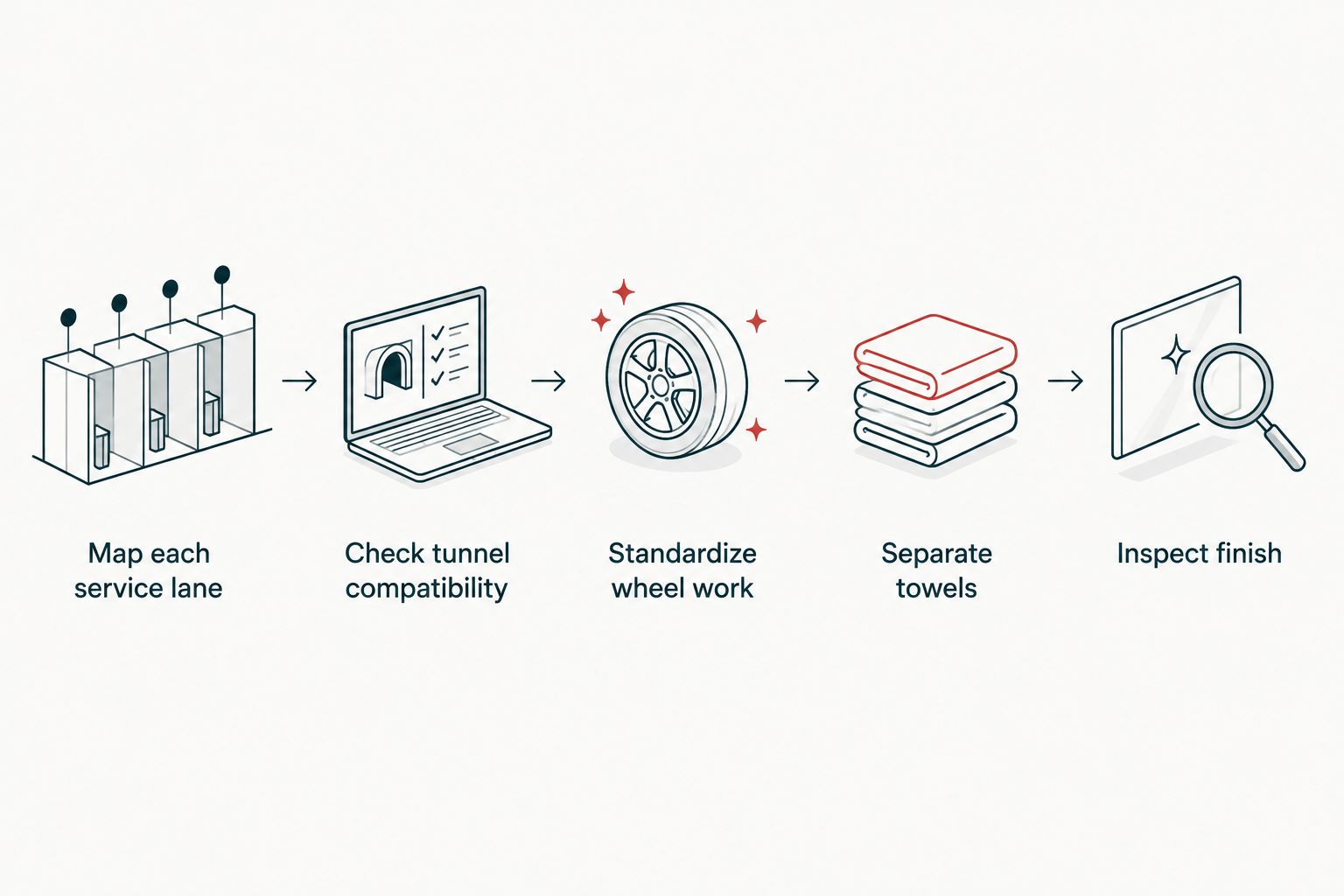
Map each service lane
Write down where the customer’s vehicle goes and which tasks staff perform there. A tunnel exit with no hand finishing has different needs from a site that also cleans wheels, vacuums interiors, or applies tire dressing. Keep the equipment-fed chemical list separate from the hand-applied detailing list in 2026.
For each lane, record the surface, application method, and person responsible. This makes it easier to spot a missing towel or brush before a shift starts. It also stops a product chosen for hand use from being treated as approved tunnel chemistry.
- List each tunnel stage that uses chemical application.
- Mark every staffed wash, drying, and finishing station.
- Note which interior and wheel services are actually offered.
- Separate routine work from stain, odor, and correction jobs.
Check tunnel compatibility before selecting chemistry
Use the equipment maker’s instructions and each chemical’s directions as the starting point for tunnel-fed products. A retail listing for a shampoo or cleaner does not establish injector compatibility, application concentration, or suitability for your equipment. Do not infer those details from a product name or a bottle size.
For hand washing beside a tunnel operation, assess shampoo against the process the employee controls: mixing, application, rinsing, and the condition of the vehicle. Run a small workflow check before making it standard. If staff cannot identify which product belongs in which station, simplify the list.
- Match each tunnel chemical to the equipment’s stated requirements.
- Read product directions before changing a dilution or applicator.
- Label hand-use and equipment-use containers distinctly.
- Record who approves a change to the wash process.
Standardize wheel and tire work
Wheel cleaning should be a defined service, not an improvised extension of the body wash. Brake dust and road grime call for attention to the wheel surface, the cleaner’s directions, and the brush or mitt used for agitation. Test an unfamiliar finish before treating the whole wheel, and keep wheel tools out of paint work.
For a staffed wheel-cleaning station, Car Candy Chocolate Thunder Acid Free Wheel Cleaner is an acid-free, concentrated wheel, tire, and whitewall cleaner listed for brake dust and road grime. Its advantage is a clear role in wheel work; its limitation is that staff still need to follow the product directions and check the surface. In 2026, assign tire dressing to the finishing step rather than mixing it into wheel cleaning.
- Designate wheel-only brushes, mitts, and towels.
- Inspect the finish before applying a wheel cleaner.
- Follow the cleaner’s application and rinse directions.
- Apply tire dressing only in the assigned finishing area.
Separate towels and tools by surface
A towel that touched a wheel should not return to painted panels. Set up distinct bins for paint, glass, interiors, and wheels, then explain the assignment where staff pick up supplies. Color coding can help, but a written surface label is what removes ambiguity when towels are replaced.
Catalog options include microfiber towels identified as 300 GSM and 350 GSM. Those figures describe listed towel weight, not a guarantee that either towel suits every surface or task. Choose by the job, inspect for trapped debris, and retire a towel from delicate finish work when its condition changes. This is a better 2026 purchasing test than choosing by GSM alone.
- Assign separate clean-towel storage for each surface.
- Keep used wheel towels out of paint-towel bins.
- Inspect mitts and towels before contact with a finish.
- Set a laundering and retirement process staff can follow.
Stock interior work for the services you perform
Interior supplies earn their place when they match an offered service. Routine touch-ups, upholstery stains, and persistent odors are different jobs; one quick detailer should not be expected to resolve all three. Start with manual inspection and a small-area test, then choose the cleaner and tool appropriate to the material and soil.
For a fast interior touch-up, the listed Car Candy Impeccable Interior Quick Detailer is described as cleaning, shining, and protecting interior surfaces with a non-greasy finish. That makes it a candidate for routine hand finishing, not proof that it replaces a dedicated stain treatment. Keep upholstery and odor procedures separate so staff know when a vehicle needs more than a wipe-down.
- Identify the interior materials included in each service.
- Test an unfamiliar cleaner on a small, less visible area.
- Keep routine wipe-down products apart from stain treatments.
- Inspect the result before returning the vehicle.
Define the finishing handoff
Decide what the operator checks after washing and before the vehicle leaves the staffed area. Water remaining around mirrors and trim, visible wheel residue, and uneven tire dressing are inspection points an employee can act on. A finishing checklist is more useful than another product when the problem is inconsistent handoff.
Car Candy Tropical Tread -Water Based Tire Dressing is listed as a ready-to-use tire protectant with a glossy finish. Its advantage is a defined tire-finishing role; its limitation is that the finish still has to match the service you promise and be applied as directed. Do not make dressing an automatic step on every vehicle unless that step belongs to the purchased service.
- Check wheels for cleaner residue.
- Check paint and glass for remaining water or marks.
- Inspect tire dressing for even application.
- Confirm completion of the customer’s selected service.


Measure what gets used and redone
Count product use against the services completed, not just the number of bottles ordered. A concentrate consumed at an unexpected rate calls for a check of mixing and application. Repeated wheel or interior rework calls for a check of instructions, tools, and inspection—not an immediate switch to a stronger chemical.
Keep the record simple enough for the team to maintain during normal operations. In 2026, review it when a product, applicator, or service step changes. The useful outcome is a clear decision: retain the process, retrain the step, or test a different product against the same job.
- Log which products each service uses.
- Record mixing instructions beside the assigned container.
- Note the task and cause when staff repeat work.
- Compare product use after a workflow change.
Compare supply options for a car wash operation
Best for an operation with both tunnel and staffed services: keep tunnel chemistry procurement separate from hands-on detailing supplies. This division gives each purchasing decision the right test. It also lets you add a wheel, interior, or finishing service without assuming the same product belongs in an automated application system.
| Option | Best for | Main advantage | Key limitation |
|---|---|---|---|
| Equipment-specified tunnel chemistry | Automated application stages | Starts with the tunnel’s operating requirements | Does not cover every staffed detailing task |
| Staffed detailing supplies from Detailing World ATL | Hand washing, wheel work, interiors, and finishing | Lets operators select products by hands-on task | A product listing does not establish tunnel compatibility |
| A combined supply plan with separate approvals | Sites offering automated washes and staffed add-ons | Keeps purchasing tied to each application method | Needs clear storage, labels, and staff instructions |
Do not judge these options by whether one bottle can be used in the most places. Judge them by whether staff can identify the correct product, use it according to directions, and inspect the result. If a site has no staffed detailing service, a large hand-application inventory creates work without serving a defined lane.
Common mistakes car wash operators make
Treating hand-use products as tunnel-approved chemistry. A cleaner that works with a brush or mitt has not thereby been cleared for automated dosing. Check equipment and product instructions before changing a tunnel process.
Putting every towel in one rotation. Wheel residue, interior soil, and paint finishing should not share an unmarked towel pool. Assign tools by surface and give used towels a clear return path.
Using one cleaner for every interior problem. A routine quick detailer, an upholstery stain treatment, and an odor product have different purposes. Inspect the material and problem before choosing the step.
Buying concentrate without a mixing procedure. Concentration changes how staff prepare a product; the name alone does not tell them how to use it. Keep the product directions accessible and label prepared containers.
Adding a finishing step without an inspection point. If no one checks residue, water marks, or dressing application, another supply item will not fix the handoff. Give the final check an owner.
FAQ
What detailing supplies do car wash operators need in 2026?
Car wash operators need supplies matched to their actual services: tunnel-compatible chemistry for automated stages and appropriate cleaners, towels, tools, and finish products for staffed work. Keep those purchasing lists separate until each product’s application is verified.
Can I use a hand-wash shampoo in a tunnel?
Use a hand-wash shampoo in a tunnel only when its directions and the equipment requirements support that application. A retail product listing alone does not establish dosing or equipment compatibility.
What is the best wheel-cleaning approach for a staffed wash?
Use a wheel cleaner suited to the surface and follow its directions with dedicated wheel tools. Car Candy Chocolate Thunder Acid Free Wheel Cleaner is an acid-free option listed for brake dust and road grime, but staff must still check the finish and rinse as directed.
Should paint and wheel work use the same microfiber towels?
No; assign separate towels to paint and wheel work. This keeps residue collected during wheel cleaning out of the paint-finishing workflow.
Is a tire dressing necessary for every car wash service?
No; apply tire dressing when it is part of the selected finishing service. Assign the application and inspection step so staff can deliver a consistent result.
How do I choose between a quick interior detailer and a stain cleaner?
Choose a quick interior detailer for the routine surface work described in its directions, and assess stains as a separate task. Identify the material and test the selected treatment before cleaning a larger area.
What should I measure when changing detailing supplies?
Track product use and repeated work against the services performed. Those records show whether to adjust the procedure, retrain a step, or test another product for the same task.
One last thing
The most useful supply list is also a station map. Put each cleaner beside its approved task, mixing directions, applicator, and inspection point. For a car wash adding staffed services in 2026, that makes Detailing World ATL’s detailing supplies easier to evaluate without confusing hand finishing with tunnel operation.