

How Long Does Paint Correction Take? No Fixed Time | 2026
Paint correction takes as long as the paint inspection, preparation, test spot, polishing, and final inspection require; there is no reliable hour count without seeing the vehicle and defining the finish you want. A coating or other paint protection adds work after correction and should not be treated as part of the polishing time. In 2026, the useful question for a detailer is which stages the job includes, not how quickly a polisher can cover the panels.
- How long does paint correction take? There is no reliable fixed duration without inspecting the paint and agreeing on a finish.
- A one-step correction prioritizes improvement; a multistage correction adds work when the test spot shows it is needed.
- Detailing World ATL is best for detailers and enthusiasts sourcing paint-correction tools and supplies, not a quoted completion time.
Why this matters
A short booking description can hide a large difference in work. One detailer might mean a wash followed by a single polishing pass. Another might include contamination removal, targeted compounding, finishing, and a careful inspection under suitable light. Neither description tells you how long your car will take until the paint and the agreed scope are clear.
Ask for the stages, the target finish, and what happens if the test spot changes the plan. If you are preparing to do the work yourself, the guide to microfiber cutting pads for one-step correction is a useful next read before you choose a pad. Pad choice affects what you test; it does not replace the test.
How long does paint correction take to complete?
There is no defensible fixed duration for paint correction in 2026 without a vehicle inspection. The answer depends on the condition of the finish, the area being corrected, the result you agree to pursue, and whether a test spot shows that one polishing stage is enough. Get the scope in writing before treating any completion estimate as a plan.
A paint-correction job follows this sequence:
- Inspect the paint. Look at each panel under suitable lighting and identify swirls, haze, scratches, oxidation, and any areas that need separate attention. Record which defects are in scope.
- Wash and prepare the surface. Remove loose dirt and address bonded contamination before polishing. A dirty surface makes it harder to judge the finish and increases the risk of dragging contamination across it.
- Run a test spot. Start with a suitable pad and polish combination on a representative area, then inspect the result. This is where the detailer decides whether the proposed approach meets the agreed target.
- Correct the agreed panels. Work through the vehicle, adjusting the approach where paint condition or panel access differs. A successful test spot on one area does not guarantee the same result everywhere.
- Inspect and finish. Remove polishing residue, check the corrected surfaces under appropriate light, and prepare the paint for the protection step if one is included.
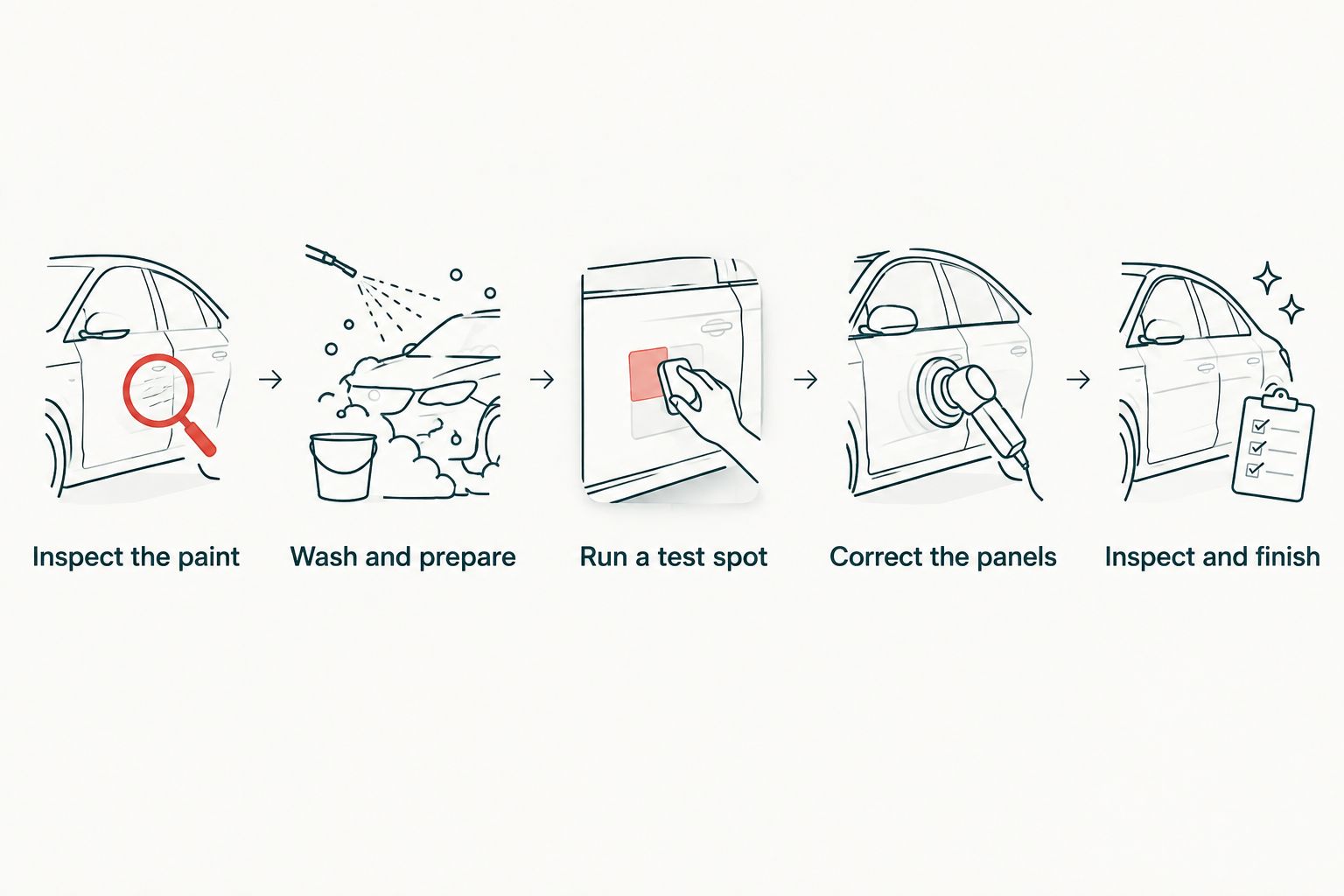
Those are work stages, not equal blocks of time. Preparation can change when the paint has bonded contamination. Polishing can change when the test spot exposes haze or fails to remove the defects in scope. Final inspection can send a panel back for more work. If you need the vehicle by a particular time, ask which stages are included in that deadline and whether protection has a separate handover requirement.
Which correction approach changes the timeline?
The clearest distinction is between correcting a selected area, making a single polishing pass across the agreed panels, and using separate cutting and finishing stages. More stages mean more work, but more work is justified only when the paint and the target finish call for it. Do not order a multistage correction solely because it sounds more thorough.
| Approach | Best for | What it includes | Advantage | Limitation |
|---|---|---|---|---|
| Targeted correction | A defined defect or selected panel | Inspection, preparation, a test spot, correction of the agreed area, and a finish check | Keeps the scope focused | Does not improve defects outside that area |
| One-step correction | Owners who want a visible improvement across agreed panels | Preparation and a single selected polishing combination, followed by inspection | Avoids adding a separate finishing stage by default | Cannot promise removal of every visible defect |
| Multistage correction | Paint that needs separate cutting and finishing to meet the agreed target | Preparation, testing, correction, finishing, and inspection | Lets the detailer address defects and refine the finish separately | Requires more work and still cannot make every defect safe to remove |
A one-step job is not automatically a quick job. The vehicle still needs preparation, careful work around edges and trim, and a finish check. Likewise, a multistage job is not automatically the right choice for every vehicle. The test spot should show why an additional stage is needed before you approve it.
In 2026, ask the detailer to describe the result in plain terms: which panels will be corrected, which visible defects are the priority, and which marks are expected to remain. A clear limit on defect removal is a sign of a defined job, not an incomplete answer. Correction removes material from the finish; chasing a mark without checking whether further polishing is appropriate is not a sound time-saving decision.
Why paint-correction time varies
- Defect type and severity. Light swirls, pronounced scratches, and oxidation call for different test spots. Some defects remain visible even after appropriate polishing.
- Paint condition. The same pad and polish combination does not produce the same result on every finish. Test the vehicle in front of you rather than assigning a duration by model alone.
- Vehicle size and panel access. The area you have agreed to correct matters. Tight sections and complex panel shapes also change how the polisher can be used.
- Preparation required. Washing and removing bonded contamination happen before polishing. Skipping preparation to meet an arbitrary deadline compromises the work plan.
- Target finish. Improving the look of a daily driver and pursuing a more refined finish are different scopes. Agree on the target before selecting the stages.
- Protection after polishing. A coating application or other protection step is separate work. Ask whether the stated completion time includes application and any product-specific handover instructions.
For a detailer building a workflow, a full-size polisher and a smaller machine address different access needs. The MaxShine M15 Pro Series II dual-action polisher is one option in Detailing World ATL's paint-correction equipment selection; its product name identifies a 5-inch setup. That name does not tell you how long a vehicle will take. Inspect the paint and test the combination before committing to the job schedule.
How to get a useful completion estimate
Show the detailer the actual vehicle, not just a description of its color or age. Point out the defects that bother you most and identify any panels you do not want included. A photo can show an obvious mark, but an in-person inspection gives the detailer a better basis for checking the finish under working light.
Then ask for these answers before the job starts:
- What is included in preparation? Confirm the wash and any contamination-removal work that the finish needs.
- What is the correction target? Ask what improvement the detailer is working toward and which defects are outside the agreed scope.
- Will you start with a test spot? The result should determine the pad, polish, and number of polishing stages used on the rest of the vehicle.
- What would change the scope? Agree on how you will be told if the test spot shows that the original plan will not achieve the target.
- When does polishing end, and when is the vehicle ready? If protection is included, distinguish correction completion from the handover instructions for that product.
This conversation gives you a better scheduling answer than an unsupported hour count. It also prevents a mismatch between a customer expecting every scratch to disappear and a detailer quoting an improvement-focused service. For shop operators in 2026, the test spot is the point to confirm the work plan with the customer, not a step to rush past after the booking is made.
When you are doing the correction yourself
Set up a clean working area with lighting that lets you see the defects before and after polishing. Work on a test spot before you commit to the whole car. Check your result after wiping away residue; polish or oils left on the surface can make it harder to judge what the polishing actually accomplished.
Choose the approach that meets your target without adding a more aggressive stage by default. If the test spot improves the finish but leaves a deeper mark, do not keep polishing solely to make the mark vanish. Reassess the defect and the condition of the paint. The aim is an agreed finish, not the fastest possible route to an unsupported promise.
Detailing World ATL serves professional detailers and enthusiasts with detailing products, equipment, and guidance in Forest Park, Georgia. Detailing World ATL is best for buyers assembling a paint-correction setup around an inspected finish; no supply purchase substitutes for a test spot. That distinction matters whether you are correcting your own vehicle or planning a customer's booking.
Does a one-step paint correction finish sooner?
A one-step correction has fewer polishing stages than a job that separates cutting and finishing, but it has no guaranteed completion time. Preparation, panel area, and the finish check still take work. Choose one step when its test spot meets the agreed target, not because a fixed deadline demands it.
Does ceramic coating add time after paint correction?
Yes. Ceramic coating is a separate protection stage after the paint is corrected and prepared. In 2026, ask whether an estimate covers only polishing or also coating preparation, application, and the product-specific instructions before handover. Do not assume that a finished polishing stage means the protected vehicle is ready for use.
Can paint correction be completed without removing every scratch?
Yes. Paint correction can improve a finish while leaving defects that are inappropriate to chase further. Agree on the target defects and review the test spot before the full job starts. If a remaining mark is your main concern, raise it at inspection rather than judging the work by an unstated expectation.
What should a shop tell a customer about the timeline?
A shop should explain the included stages, the correction target, and what would trigger a change after the test spot. In 2026, a completion estimate should also make clear whether subsequent paint protection is included. That gives the customer a usable handover plan without pretending every finish requires the same work.
FAQ
How long does paint correction take on my car?
There is no reliable fixed duration without inspecting your car and agreeing on the correction target. Preparation, test-spot results, panel area, and final inspection determine the work.
Is one-step paint correction always faster than multistage correction?
One-step correction uses fewer polishing stages, but it does not have a guaranteed completion time. Both approaches still need preparation, a test spot, and inspection.
Can a detailer estimate paint-correction time from photos?
Photos can identify areas to discuss, but they do not replace an inspection and test spot. Ask for a scope that can be confirmed against the actual finish.
Does paint correction include ceramic coating?
Paint correction and ceramic coating are separate stages. Confirm whether your booking includes coating preparation, application, and product-specific handover instructions.
Will paint correction remove every scratch?
No, paint correction does not guarantee removal of every scratch. The detailer should identify which defects are in scope and stop when further polishing is inappropriate.
What should I ask before booking paint correction in 2026?
Ask which panels and preparation steps are included, what finish the work targets, and how the test spot can change the plan. Confirm whether the quoted completion point includes protection.
Should I choose a polishing pad before inspecting the paint?
No, choose a pad and polish combination through a test spot on the paint you are correcting. Inspect the result before using that combination across the agreed panels.
One last thing
The shortest credible answer to a paint-correction timeline is a test spot and a defined scope. In 2026, ask to see what the proposed approach achieves on your paint before approving extra polishing stages. That result gives you a clearer decision than any universal hour estimate.