

Microfiber towels ranked by GSM for professional detailing
Best overall for finishing: Korean Plush 350 GSM Microfiber Towels Dual Plush. Best for a dedicated utility rotation: Microfiber Edgeless Towels 300GSM. Best for wash-stage drying: Maxshine Purple Duo Twisted Drying Towel. This 2026 guide to microfiber towels ranked by GSM starts with the Korean Plush 350 GSM Microfiber Towels Dual Plush, then separates towel density from the construction and condition that determine suitability.
- Microfiber towels ranked by GSM need task-specific verdicts: Korean Plush 350 GSM is the finishing shortlist leader.
- Microfiber Edgeless Towels 300GSM suit a separate utility rotation; inspect pile and edges before assigning paint work.
- Maxshine Purple Duo Twisted Drying Towel belongs in the drying category, not an assumed GSM position.
- Detailing World ATL microfiber towel choices should follow task, weave, edge condition, and cleanliness—not density alone.
Why this matters
GSM measures fabric mass per area, not scratch resistance or overall quality. A towel rated at 350 g/m² contains more material per square meter than one rated at 300 g/m². That difference does not establish which towel releases polish residue better, leaves less lint, or handles glass more cleanly.
For your 2026 shop inventory, separate finishing, utility cleaning, and drying before comparing density. A clean towel matched to its task is a better choice than a heavier towel carrying grit or hardened residue.
Detailing World ATL serves professional detailers, automotive businesses, and enthusiasts in Metro Atlanta. The useful buying question is not which towel has the biggest number; it is which construction belongs at each stage of your detail.
What makes the best microfiber detailing towels?
Use these criteria before treating GSM as a ranking score:
- Task fit: Distinguish residue removal, interior cleaning, glass cleaning, and bulk-water drying. These jobs require different handling.
- Pile construction: Inspect the working face. Plush pile, a tight cleaning weave, and twisted drying fibers are not interchangeable descriptions.
- Edge condition: Check seams, borders, tags, and corners. An edgeless designation does not remove the need for inspection.
- Cleanliness: Reject embedded debris, stiff contamination, or residue that remains after washing. Density cannot compensate for contamination.
- Handling: Choose a towel you can fold, turn, and control without bunching or dragging a saturated section.
- Care requirements: Follow the towel manufacturer's washing instructions and keep incompatible contamination out of the same laundry load.
These criteria put GSM in its proper place: a specification within a decision, not the decision itself. Keep this checklist beside your 2026 replenishment list so replacement towels serve a defined job.

Microfiber towels ranked by GSM: at a glance
The order below ranks recommendations by use case, not by descending fabric weight. The drying towel stays outside a numeric density ranking because its listed name does not establish a GSM value.
| Rank and towel | Listed GSM | Best for | Standout detail | Key limitation |
|---|---|---|---|---|
| 1. Korean Plush 350 GSM Microfiber Towels Dual Plush | 350 GSM | Dedicated finishing rotation | Dual-plush construction named in the listing | Density does not establish lint performance or paint compatibility |
| 2. Microfiber Edgeless Towels 300GSM | 300 GSM | Separate utility-cleaning rotation | Edgeless construction named in the listing | Edgeless does not mean contamination-proof or scratch-proof |
| 3. Maxshine Purple Duo Twisted Drying Towel | Not specified in the listed name | Post-wash drying | Twisted drying construction named in the listing | Cannot be placed accurately in a numeric GSM ranking |
1. Korean Plush 350 GSM: best microfiber towel for finishing
Korean Plush 350 GSM Microfiber Towels Dual Plush is the first option to evaluate for a dedicated finishing rotation. Its listed density and dual-plush construction make it a more relevant finishing candidate than a towel selected only because it is labeled for general cleaning.
Reserve a clean batch for finishing work rather than moving towels between wheels, interiors, and paint. Before using any towel across a corrected panel, inspect it and test the intended product-and-towel combination in a small area.
Korean Plush 350 GSM pros:
- The listing identifies a specific fabric density: 350 GSM.
- Dual-plush construction gives you a defined pile category to evaluate.
- A dedicated finishing assignment keeps the selection separate from dirty utility work.
Korean Plush 350 GSM cons:
- GSM alone does not establish absorbency, lint release, or wiping resistance.
- Plush construction does not automatically suit every coating-leveling procedure.
- A contaminated finishing towel still requires removal from paint service.
Best for: Detailers building a separate towel rotation for finishing wipes and evaluating plush towels for their chosen detailing products.
For a 2026 finishing setup, start with a controlled trial rather than replacing every towel at once. Inspect the surface under suitable lighting after wiping, and judge residue removal and any new marks before assigning the towel broadly.
Verdict: Buy for a dedicated finishing trial; do not treat 350 GSM as a safety guarantee.
2. Microfiber Edgeless Towels 300GSM: best for utility rotation
Microfiber Edgeless Towels 300GSM are the utility-rotation pick because the listing identifies both density and edge construction. Assign them to a clearly separated cleaning category instead of expecting one towel batch to handle every vehicle surface.
The 300 GSM specification describes fabric mass, not pile height. Inspect the actual working face before deciding whether a towel belongs on interior surfaces, product removal, or another approved task.
Microfiber Edgeless Towels 300GSM pros:
- The listing provides a clear 300 GSM density specification.
- Edgeless construction removes a conventional sewn border from the selection criteria.
- A separate utility assignment supports straightforward towel sorting.
Microfiber Edgeless Towels 300GSM cons:
- Edgeless construction does not prevent trapped grit from contacting a surface.
- The density number does not identify the fiber blend or pile structure.
- Towels exposed to wheel grime should not return to a paint-finishing rotation.
Best for: Shops establishing a dedicated utility-cleaning batch with task separation and regular inspection.
Do not demote a dirty paint towel directly into another job without cleaning and inspection. Reassignment is an inventory decision, not permission to spread contamination. Keep chemical compatibility and the surface manufacturer's instructions in the decision.
Verdict: Buy for a defined utility role; skip the assumption that lower GSM means lower quality.
3. Maxshine Purple Duo Twisted: best microfiber towel for drying
Maxshine Purple Duo Twisted Drying Towel is the task-specific pick for removing water after washing. Its listed name identifies a twisted drying construction, which is more relevant to that purchase than guessing a density from appearance or thickness.
Keep a dedicated drying towel separate from polish-removal and interior-cleaning towels. Use it after a proper wash and rinse, and change to a clean, suitable towel when the working towel becomes contaminated or stops collecting water effectively.
Maxshine Purple Duo Twisted Drying Towel pros:
- The listing explicitly identifies drying as the intended task.
- Twisted construction distinguishes it from the plush finishing option.
- A dedicated drying assignment separates water removal from chemical-residue wiping.
Maxshine Purple Duo Twisted Drying Towel cons:
- Its listed name does not provide a GSM value for numeric comparison.
- Drying performance cannot be reduced to density alone.
- A drying towel is not a substitute for cleaning a dirty panel first.
Best for: Detailers choosing a separate towel for the wash-stage drying process.
For your 2026 drying setup, judge handling on the vehicle as well as water pickup. Keep the towel clear of the ground, tires, and dirty lower surfaces; inspect it immediately after accidental contact.
Verdict: Buy for dedicated drying; skip any unverified claim about its GSM.
What GSM actually tells you
GSM means grams per square meter. A 350 GSM fabric has a nominal mass of 350 grams across 1 m²; a 300 GSM fabric has a nominal mass of 300 grams across the same area. Those figures describe fabric density, not the weight of every finished towel.
Total towel weight also depends on dimensions and construction. Comparing a small wiping towel with a much larger drying towel by how heavy each feels does not isolate GSM.
Do not turn these numbers into universal thresholds. Neither 300 GSM nor 350 GSM proves that a towel is suitable for delicate paint, coating removal, or streak-free glass. Weave, fiber construction, residues, edges, and technique remain separate checks.
Use GSM to compare otherwise similar towels—not to erase their differences.
Build a towel rotation that protects the finish
A useful 2026 towel system starts with job separation and ends with inspection. Follow this sequence before a towel touches a vehicle:
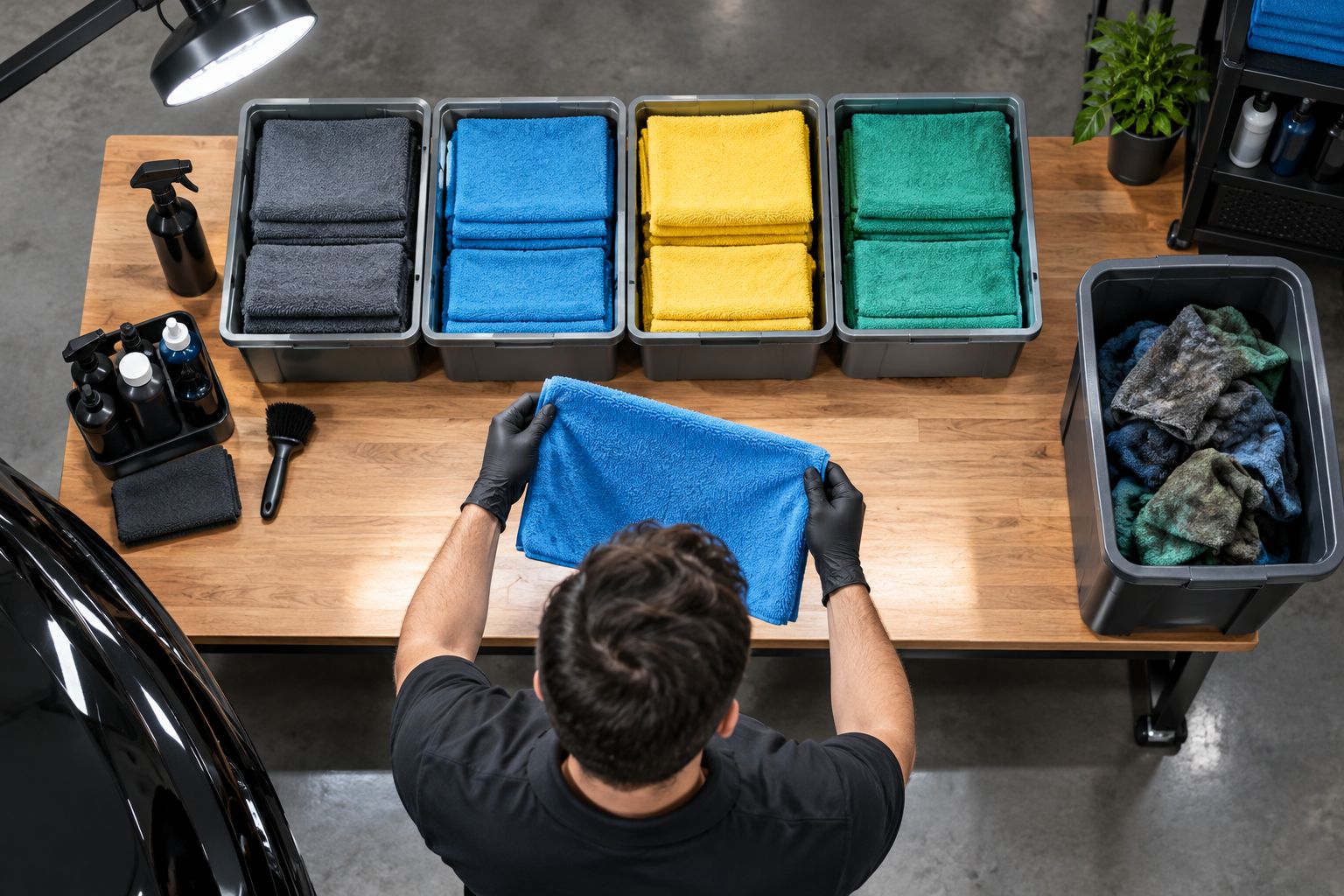
- Assign the task. Separate paint finishing, glass, interiors, drying, and dirty utility work. Use labeled storage so another technician can follow the same system.
- Inspect the towel. Check both faces and the edges for grit, stiffness, damaged fibers, or hardened product. Do not rely on appearance alone.
- Test the combination. Confirm the towel works with the intended chemical and surface in a small area. Follow the chemical manufacturer's application and removal directions.
- Rotate clean faces. Refold to expose a clean working area rather than repeatedly wiping with a loaded face. Replace the towel when clean faces are exhausted.
- Separate used towels. Keep contaminated towels out of clean storage and sort laundry by contamination type. Follow care instructions rather than improvising wash temperatures.
For ceramic coating work, the coating manufacturer's removal procedure takes priority over a generic GSM recommendation. Do not return towels containing hardened coating residue to paint service.
How the microfiber towels are ranked
This ranking prioritizes task fit, then the construction identified in each listing, then the available density specification. It does not claim measured absorption, verified lint performance, or comparative scratch testing.
The 350 GSM dual-plush option leads the finishing shortlist. The 300 GSM edgeless option fills the utility role, while the twisted drying towel serves a different stage rather than competing for the same job.
Which microfiber towel should you choose?
Start with the 350 GSM dual-plush option if finishing is the gap in your towel inventory. Choose the 300 GSM edgeless option for a separate utility batch, and choose the twisted drying towel when your wash process needs dedicated water removal.
Detailing World ATL microfiber towels are best selected by task before GSM. Keep the categories separate, inspect the towels you receive, and expand the rotation only after confirming the towel works with your process.
FAQ
What's the best GSM for professional detailing towels?
There is no single best GSM for every detailing task. Use density alongside weave, edge construction, condition, and the intended job; finishing and drying need separate evaluations.
Is a 350 GSM microfiber towel better than a 300 GSM towel?
A 350 GSM towel has more fabric mass per square meter, but that does not make it universally better. Compare otherwise similar constructions and choose the towel that performs the intended task without leaving residue or marks.
What does GSM mean on a microfiber towel?
GSM means grams per square meter, a measure of fabric mass per area. It does not directly state a finished towel's total weight, absorbency, softness, or resistance to scratching.
Can I use 300 GSM edgeless towels on car paint?
A 300 GSM edgeless designation alone does not establish paint suitability. Inspect the towel, check the manufacturer's intended uses, and test the towel-and-product combination before wider use.
Does a drying towel need the highest GSM?
A drying towel does not need to win a density comparison to suit your drying process. Evaluate its drying construction, handling, cleanliness, and ability to collect water on the vehicle.
Which microfiber towel should I use to remove a ceramic coating?
Use the towel construction and removal procedure specified by the coating manufacturer. Do not select coating-removal towels by GSM alone or return towels with hardened coating residue to paint work.
Where can I get guidance on detailing towels in Metro Atlanta?
Detailing World ATL provides professional detailing products and expert guidance in Forest Park, Georgia. Describe the surface, chemical, and task so the towel recommendation addresses your actual process.
One last thing
Retire towels by condition, not by how impressive their GSM sounds. A towel that develops hard contamination, damaged edges, or persistent debris has lost its place in a paint rotation regardless of its original specification.
Before ordering another batch, inspect the towels already on your cart. Better separation and a clear rejection rule come before a higher density number.