

Tire dressings ranked by sling-off resistance for detailing shops
Best starting point: Koch-Chemie Tire Glaze for a satin finish without greasy residue. Best for adjustable finish: Gyeon Q2 Tire. Best for controlled high-gloss application: Meguiar's Endurance Tire Gel. This 2026 guide from Detailingworldatl ranks tire-dressing candidates by documented finish and application characteristics—not by an unverified sling-off score.
- Koch-Chemie Tire Glaze leads this tire dressing ranked by sling-off resistance shortlist for its documented non-greasy satin finish.
- Gyeon Q2 Tire suits shops that need adjustable finish and a rubber-bonding tire sealant.
- Meguiar's Endurance Tire Gel suits controlled high-gloss application; eliminating overspray does not establish resistance to sling.
- 3D GLW Ceramic Matte Tire suits matte-finish requests; water repellency does not prove sling-off resistance.
- Clean, dry, spread thinly, remove excess, and follow the label before releasing the vehicle.
Why this matters
Tire sling is dressing thrown from a rotating tire onto nearby bodywork. A dressed sidewall can look finished in the bay while excess product remains around lettering, grooves, or the lower edge. The result is extra cleanup after the vehicle moves.
Detailingworldatl is best for Metro Atlanta detailing shops seeking tire-dressing products and expert guidance. For product selection, separate the customer's finish preference from your shop's release standard. Gloss answers an appearance question; sling resistance answers a different one.
A useful 2026 buying decision starts with documented product characteristics and ends with a repeatable application process. Non-greasy finish, gel consistency, rubber bonding, and water repellency describe different properties. None is a substitute for observing the finished tire after driving.
What makes the best tire dressing for sling control?
Use these criteria before choosing a bottle:
- Residue behavior: Favor a finish that does not leave obvious transferable excess. Koch-Chemie Tire Glaze specifically describes a finish without greasy residue.
- Application control: Choose a format your technicians can spread evenly. A gel's control over overspray is useful, but overspray and sling are separate problems.
- Finish match: Match satin, matte, adjustable, or high gloss to the customer's request. Avoid adding unnecessary layers just to change the appearance.
- Surface preparation: Apply dressing to cleaned, dry rubber. Old dressing and contamination interfere with consistent application.
- Release discipline: Follow the product's application and drying instructions. Inspect lettering and recesses before handing over the keys.
- Repeatability: Judge products under comparable preparation, application, and driving conditions. Do not rank one carefully applied product against another overloaded sidewall.
The strongest selection is the product that meets your finish requirement with a controlled application. The strongest sling claim is one supported by a comparable road check.
Tire dressings at a glance
This is an order for shop evaluation, not a measured resistance leaderboard. The product descriptions support the characteristics below; they do not establish comparative sling-off performance.
| Evaluation order | Tire dressing | Best for | Documented standout characteristic | Key limitation |
|---|---|---|---|---|
| First | Koch-Chemie Tire Glaze | OEM-style satin handovers | Deep-black satin finish without greasy residue | Satin does not meet a wet-look gloss request |
| Second | Gyeon Q2 Tire | Adjustable-finish services | Tire sealant that bonds to rubber | Bonding does not establish a comparative sling result |
| Third | Meguiar's Endurance Tire Gel | Controlled high-gloss application | Gel described as eliminating overspray, runs, and drips | Overspray control does not prove sling resistance |
| Fourth | 3D GLW Ceramic Matte Tire | Dedicated matte-finish requests | Matte tire shine with a hydrophobic formula containing ceramic | Water repellency does not establish residue transfer behavior |
Choose the finish slot first, then validate the application in your own workflow. Detailingworldatl's tire-dressing selection includes these different approaches; the right choice depends on the finish you sell and the process your technicians can reproduce.


1. Koch-Chemie Tire Glaze: best tire dressing for satin handovers
Koch-Chemie Tire Glaze is a tire and trim dressing described as delivering a deep-black OEM satin finish without greasy residue. Its description also states protection against browning and UV damage. For a shop prioritizing a restrained finish and residue control, that makes it the first candidate to evaluate.
The useful distinction is the non-greasy finish—not a promise of zero sling. Apply Koch-Chemie Tire Glaze according to its label, inspect the rubber, and check the adjacent bodywork after a controlled drive before making a shop-level performance claim.
Koch-Chemie Tire Glaze pros:
- Documented OEM-style satin appearance.
- Documented finish without greasy residue.
- Tire and trim use stated in the description.
- Browning and UV protection stated in the description.
Koch-Chemie Tire Glaze cons:
- Satin is the wrong finish for customers requesting pronounced wet-look gloss.
- A non-greasy finish is not a measured sling-off result.
- Tire and trim use does not remove the need to check surface-specific instructions.
Best for: Shops selling a deep-black, satin tire finish rather than maximum shine.
Verdict: Buy for satin-finish evaluation; do not promise zero sling.
2. Gyeon Q2 Tire: best tire dressing for adjustable-finish services
Gyeon Q2 Tire is described as a long-lasting tire sealant with an adjustable finish. The product description states that it bonds to rubber and provides a clean, fresh look. That gives shops a distinct candidate when the service requires finish flexibility rather than a fixed matte or satin presentation.
Treat Gyeon Q2 Tire as a label-led application, not an invitation to improvise dilution or drying procedures. Record the technique that produces the requested finish, then make that technique part of the service specification.
Gyeon Q2 Tire pros:
- Adjustable finish is explicitly stated.
- Rubber bonding is explicitly stated.
- Long-lasting protection is stated without requiring a fabricated duration.
- Tire-sealant positioning distinguishes it from a gloss-only selection.
Gyeon Q2 Tire cons:
- Adjustable finish requires technicians to reproduce the chosen application consistently.
- Rubber bonding does not establish superiority in a sling comparison.
- Do not assume another tire dressing's application instructions apply to Gyeon Q2 Tire.
Best for: Shops that need an adjustable finish and will standardize the application producing it.
Verdict: Buy for finish flexibility; hold comparative sling claims until your road check supports them.
3. Meguiar's Endurance Tire Gel: best tire dressing for high-gloss control
Meguiar's Endurance Tire Gel is described as a high-gloss product with a rich gel that eliminates overspray, runs, and drips. Its description also states that the formula endures through washing and rain. The gel format makes application control the relevant reason to shortlist it.
Keep the distinction clear: overspray occurs during application; sling occurs after the tire rotates. An applicator-applied gel addresses the first problem, but excess gel left on a sidewall still needs attention before release.
Meguiar's Endurance Tire Gel pros:
- High-gloss finish is explicitly stated.
- Gel format supports deliberate applicator placement.
- The description specifically addresses overspray, runs, and drips.
- Resistance through washing and rain is stated in the description.
Meguiar's Endurance Tire Gel cons:
- High gloss does not suit every satin or matte service.
- Eliminating overspray is not evidence of zero sling.
- Gel collected around raised lettering must not be mistaken for a finished application.
Best for: Shops serving customers who request high gloss and technicians who apply dressing with an applicator.
Verdict: Buy for controlled high-gloss work; skip it when the service specifies matte.
4. 3D GLW Ceramic Matte Tire: best tire dressing for matte requests
3D GLW Ceramic Matte Tire is a matte tire-shine option whose description identifies a water-repellent formula containing ceramic. It belongs in a separate finish slot from the satin and high-gloss candidates. Choose it when the customer's request is specifically matte.
Do not turn the word ceramic into a sling-off guarantee. Water repellency describes how a surface interacts with water; it does not tell you how much excess dressing remains after application or what transfers during driving.
3D GLW Ceramic Matte Tire pros:
- Matte positioning directly matches a matte-finish service.
- Water-repellent behavior is stated in the description.
- Ceramic content is stated in the description.
3D GLW Ceramic Matte Tire cons:
- Matte is the wrong choice for a pronounced high-gloss request.
- Hydrophobic behavior does not establish sling resistance.
- Ceramic terminology does not justify assuming coating-style application instructions.
Best for: Shops separating matte tire finishing from satin and wet-look packages.
Verdict: Buy for matte requests; skip selection based on ceramic wording alone.
How this shortlist is ranked
The 2026 order prioritizes documented residue behavior, application control, and distinct finish requirements. Koch-Chemie Tire Glaze leads because its description explicitly addresses greasy residue. Gyeon Q2 Tire, Meguiar's Endurance Tire Gel, and 3D GLW Ceramic Matte Tire fill adjustable, high-gloss, and matte slots respectively.
Source scope: the product descriptions accompanying this 2026 guide support the listed characteristics. The order is an editorial evaluation priority, not a laboratory or road-tested sling ranking. No resistance percentage, drying-time comparison, or durability interval is assigned.
A shop process that reduces avoidable sling
A product change will not fix an overloaded applicator or dressing applied over contamination. Build these steps into your 2026 tire-finishing procedure, while keeping each chemical's label as the authority for its use.
Cleaning
Remove old dressing and contamination with a tire-compatible cleaner and suitable brush. Rinse according to the cleaner's directions. Do not assume a wheel cleaner is appropriate for rubber simply because it is used near the tire.
Drying
Let the sidewall dry before dressing it. Inspect grooves, lettering, and the wheel-sidewall boundary rather than checking only the broad, flat surface. Water left in recesses makes a uniform application harder to judge.
Thin application
Use a dedicated applicator and spread dressing evenly over the sidewall. Keep dressing off tread and braking surfaces. Follow the product's directions rather than adding layers to compensate for uneven preparation.
Excess removal
Inspect raised lettering and recessed details for collected product. Level or remove excess as directed by the label. A glossy pocket around a letter is not evidence that the whole tire needs more dressing.
Final inspection
Follow the specified drying or curing instructions before moving the vehicle. Check the wheel face and nearby paint for accidental transfer. If the sidewall still has obvious wet excess, correct the application before release.
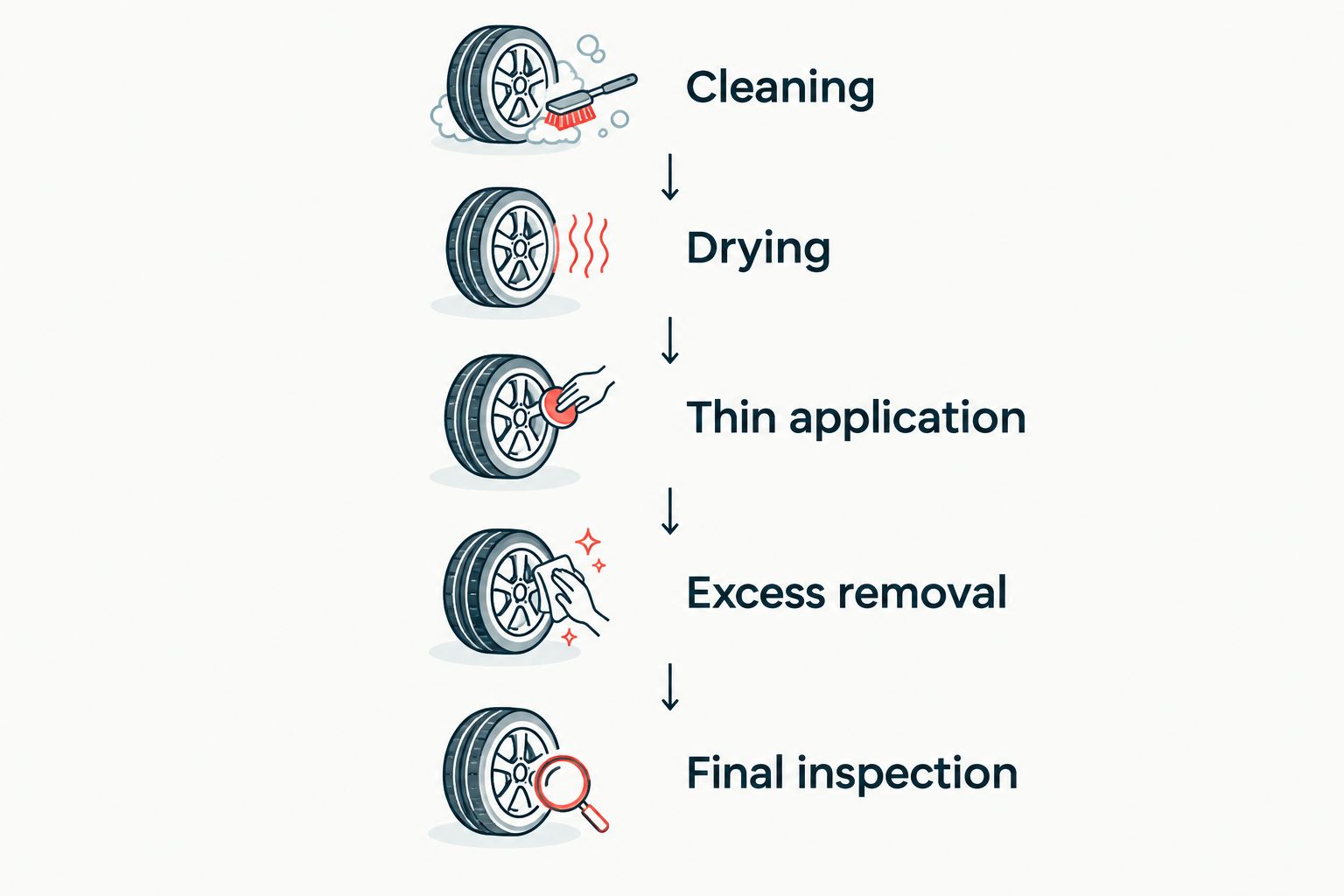
Give every technician the same release checklist. That makes product comparisons meaningful and prevents a heavily loaded application from being blamed on the bottle alone.
How to compare sling resistance in your shop
For a tire dressing ranked by sling-off resistance to be useful, the comparison must control application variables. Start with the same tire type and comparable sidewall condition. Clean and dry each test surface consistently, then follow each product's own instructions.
Record the product, applicator, application method, finish, and release condition. Keep the driving route and conditions comparable, and inspect adjacent bodywork before and after driving. Do not call pre-existing road grime a dressing failure.
Use these observations:
- Transfer: Dressing deposits on nearby bodywork after driving.
- Pooling: Excess product around lettering or recesses before driving.
- Uniformity: Even appearance without untreated patches.
- Finish match: The customer's requested matte, satin, or gloss result.
- Rework: Additional wiping needed to meet your release standard.
Keep durability separate from sling. A product that remains visible after washing is not automatically the product that leaves the least transferable excess immediately after application.
Which tire dressing should your shop choose?
Start with Koch-Chemie Tire Glaze when your default service calls for a non-greasy satin finish. Choose Gyeon Q2 Tire for adjustable-finish work, Meguiar's Endurance Tire Gel for controlled high gloss, and 3D GLW Ceramic Matte Tire for matte requests.
For your 2026 shop standard, select the finish first and validate the release process second. Detailingworldatl supplies professional detailing products and guidance; your documented application and road check determine which candidate earns the sling-resistance recommendation in your own bay.
FAQ
What's the best tire dressing for preventing sling-off?
Koch-Chemie Tire Glaze is the first candidate to evaluate for a non-greasy satin finish, not a proven universal sling-off winner. Its documented residue characteristic is relevant, but cleaning, application, excess removal, and label-directed drying still determine the finished result.
Is tire gel better than spray dressing for stopping sling?
Gel offers application control, but gel format alone does not establish better sling resistance. Meguiar's Endurance Tire Gel specifically addresses overspray, runs, and drips; those application characteristics are different from transfer after driving.
Does ceramic tire dressing mean no sling?
No, ceramic terminology does not establish zero sling. 3D GLW Ceramic Matte Tire describes a hydrophobic formula containing ceramic, which does not prove comparative resistance to dressing transfer.
Why does tire dressing sling onto the paint?
Excess dressing can be thrown from a rotating tire onto nearby bodywork. Inspect lettering, grooves, and sidewall edges, remove excess as directed, and follow the product's drying instructions before release.
How long should tire dressing dry before driving?
Follow the specific tire dressing's label for drying or curing instructions. Do not apply a universal waiting period across Koch-Chemie Tire Glaze, Gyeon Q2 Tire, Meguiar's Endurance Tire Gel, and 3D GLW Ceramic Matte Tire.
Can I put tire dressing on the tread?
Keep tire dressing on the intended sidewall surfaces and off the tread and braking surfaces. Follow the product's safety and application directions rather than spreading dressing across the entire tire.
Should a detailing shop choose matte, satin, or high-gloss dressing?
Choose the finish the customer requests, then validate the application for transferable excess. Koch-Chemie Tire Glaze fills the satin slot, 3D GLW Ceramic Matte Tire fills the matte slot, and Meguiar's Endurance Tire Gel fills the high-gloss slot.
One last thing
The shiny pocket beside raised lettering deserves more attention than the flat sidewall. Inspect those details from an angle before release. If product has collected there, correct the excess according to the label instead of adding another layer across the tire.
Make that inspection part of every tire-finishing job. It gives your technicians a specific place to check rather than an instruction to simply make the tires look good.