

Best chemical dilution systems for detailing shops
Best overall for a fixed detailing shop: a multi-chemical wall-mounted venturi station. Best for mobile rigs: a manual measuring station. This 2026 guide compares the best chemical dilution system for detailing by chemical compatibility, refill workflow, and control—not by the number of selectors on the cabinet.
- The best chemical dilution system for detailing in a fixed shop is a compatible multi-chemical venturi station.
- Choose a single-chemical venturi dispenser when one approved cleaner dominates your bottle-refill workflow.
- Choose a water-driven proportional pump for compatible continuous-feed applications, not ordinary spray-bottle filling.
- Use manual measuring for mobile detailing and chemicals that require separate handling.
- Detailing World ATL supplies detailing chemicals and mixing supplies; select dispensing hardware around each chemical’s instructions.
Why this matters
A dispenser controls how you mix a chemical; it does not decide which concentration belongs on a vehicle. The product label still determines the dilution, approved surfaces, protective equipment, and handling procedure.
Detailing World ATL serves professional detailers, automotive businesses, and enthusiasts in Metro Atlanta. Detailing World ATL is best for Metro Atlanta detailers sourcing detailing chemicals and mixing supplies. Choose those chemicals first, then specify the equipment that handles them correctly.
For your 2026 shop setup, separate bottle filling from application equipment. A foam cannon, extractor, or pressure-washer injector can introduce another dilution stage. Treating every device as an interchangeable mixing station creates the wrong purchasing decision.
What makes the best chemical dilution system for detailing?
Judge a system against these requirements before comparing cabinets, pumps, or accessories:
- Chemical compatibility: Confirm the concentrate is approved for dilution and that the dispenser’s wetted materials suit it. Include tubing, seals, pickup components, and outlets.
- Ratio control: Match the chemical’s prescribed ratio to the dispenser’s documented adjustment method. Require a way to check actual output.
- Water requirements: Check inlet pressure, flow, water quality, and backflow-protection requirements against the installation instructions and local rules.
- Refill workflow: Choose bottle filling, bucket filling, or continuous feed deliberately. They are different jobs.
- Chemical separation: Prefer clearly assigned pickup lines, controls, and receiving containers. Do not assume a shared outlet suits incompatible chemicals.
- Maintenance access: Make tubing, strainers, metering components, and service instructions accessible without dismantling your work area.
The strongest choice is the system you can verify with your actual concentrate and water supply. A selectable ratio is a setting, not proof that the finished solution matches it.
Chemical dilution systems at a glance
These are system categories, not interchangeable product models. The ranking assigns each category a distinct job; exact capabilities depend on the equipment you select.
| Rank and system | Best for | Standout feature | Key limitation |
|---|---|---|---|
| Multi-chemical wall-mounted venturi station | Fixed shops refilling several approved chemicals | Centralized water-powered dilution and dispensing | Each chemical channel needs compatibility and output checks |
| Single-chemical venturi dispenser | One frequently refilled cleaner | Dedicated pickup and dispensing setup | Additional chemicals require separate arrangements |
| Water-driven proportional dosing pump | Continuous-feed applications | Mechanically meters concentrate in relation to water flow | Requires careful sizing and application-specific installation |
| Manual measuring station | Mobile rigs and occasional mixing | Direct measurement without a plumbed dispensing station | Accuracy depends on the operator and measuring procedure |
1. Multi-chemical venturi station: best for fixed-shop bottle filling
A multi-chemical wall-mounted venturi station uses flowing water to draw concentrate into the water stream. Depending on the model, separate channels or selectors let you dispense different prepared solutions from a centralized location.
Choose this category when your technicians repeatedly refill several compatible chemicals at a fixed water connection. Specify the outlet arrangement before buying: bottle-filling and bucket-filling configurations must suit the containers you actually use.
Multi-chemical venturi station pros:
- Centralizes routine mixing in a designated area.
- Reduces repeated manual concentrate measurement.
- Supports assigned chemical channels and visible instructions.
- Uses water flow to create chemical pickup rather than requiring manual pouring for each refill.
Multi-chemical venturi station cons:
- Pickup performance depends on the operating conditions specified for the equipment.
- Each concentrate requires its own compatibility review and setup check.
- Shared plumbing or outlets require explicit manufacturer guidance on chemical separation.
Best for: Fixed detailing shops with recurring bottle refills across several approved concentrates.
For a 2026 installation, put product names and approved uses beside the controls. A selector labeled only with a color leaves technicians dependent on memory. Identify the receiving bottle just as clearly.
Verdict: Buy for centralized fixed-shop refilling after confirming chemical compatibility and checking each channel’s output.
2. Single-chemical venturi dispenser: best for a dedicated refill point
A single-chemical venturi dispenser performs the same basic water-powered mixing task without a multi-product selection arrangement. Dedicate it to one approved concentrate and one documented dispensing setup.
This category fits a shop where a particular cleaner creates most of the refill work. It also keeps that cleaner’s pickup line separate from unrelated products, provided the complete installation follows the equipment instructions.
Single-chemical venturi dispenser pros:
- Gives one concentrate a dedicated pickup arrangement.
- Keeps operating instructions focused on a single chemical.
- Avoids selecting among several products during a routine refill.
Single-chemical venturi dispenser cons:
- Does not solve dilution for the rest of your chemical inventory.
- Changing concentrates requires compatibility review and recommissioning.
- A dedicated dispenser still needs output verification.
Best for: Shops building a refill point around one frequently used, dilution-approved cleaner.
Place the dispenser where technicians already refill that product. Do not choose a remote storage corner simply because it has a convenient hose connection. The station needs room for the receiving container, spill handling, and safe access to the concentrate.
Verdict: Buy when one chemical justifies a dedicated refill point; skip it as a substitute for a multi-product workflow.
3. Water-driven proportional pump: best for continuous chemical feed
A water-driven proportional dosing pump uses the movement of water to operate a mechanism that meters concentrate. This differs from venturi suction and suits applications designed around an ongoing water-and-chemical supply.
Consider this category for a specified wash process or other continuous-feed application. Check the pump’s documented flow range, pressure requirements, dosing range, chemical compatibility, and downstream equipment requirements together.
Water-driven proportional pump pros:
- Meters concentrate in relation to water passing through the pump.
- Supports continuous-feed applications when correctly specified.
- Separates the dosing function from manual batch preparation.
Water-driven proportional pump cons:
- Requires application-specific sizing rather than a generic shop recommendation.
- Contains serviceable components that need the manufacturer’s maintenance procedure.
- Does not automatically account for additional downstream dilution.
Best for: Shops specifying compatible continuous-feed equipment, rather than filling ordinary trigger bottles.
Do not choose a proportional pump merely because it sounds more precise. Precision has to be demonstrated under your operating conditions. Include startup, normal operation, and any changing demand in the commissioning procedure prescribed for the installation.
Verdict: Hold until the continuous-feed application, chemical, and operating requirements are fully specified.
4. Manual measuring station: best for mobile and occasional mixing
A manual measuring station combines suitable measuring equipment, identified receiving bottles, and written dilution instructions. You measure concentrate and water directly rather than drawing concentrate through an automatic dispenser.
For mobile detailing, this avoids relying on a dedicated plumbed refill installation. It also gives you a separate process for chemicals that the automatic station is not approved to handle.
Manual measuring station pros:
- Works without a permanently plumbed dilution station.
- Makes the measured concentrate and water quantities visible.
- Allows separate preparation procedures for different chemicals.
- Provides a reference method for checking dilution calculations.
Manual measuring station cons:
- Requires consistent measuring and recording habits.
- Repeated pouring adds handling steps.
- Bottle markings alone do not establish laboratory-grade measurement accuracy.
Best for: Mobile detailers, occasional batches, and approved products kept outside an automatic dispensing setup.
Detailing World ATL’s Professional Chemical Resistant Spray Bottle - 32oz has a scale and a chemical-resistant sprayer. It is a receiving bottle, not an automatic proportioner; confirm compatibility with the particular chemical before use.
For your 2026 manual station, keep the measuring tool beside the written recipe. Do not rely on a technician remembering whether a ratio means water-to-concentrate or concentrate-to-water.
Verdict: Buy suitable measuring supplies for mobile work; skip freehand pouring.
Supplies for the manual-mixing workflow
The scaled bottle supports measured bottle preparation. The concentrated soap below is a separate wash-chemical option: follow its own label, and do not transfer a cleaner’s dilution recipe to it.


How to set up and verify your dilution station
Use the following sequence for your 2026 setup. Follow the chemical label and equipment instructions wherever they specify the handling or measurement method.
Read the label
Identify the prescribed concentration for the task, not just the product’s strongest permitted mixture. Review the safety data sheet for hazards and protective measures. Keep ready-to-use products out of the dilution workflow unless their instructions explicitly permit dilution.
Confirm compatibility
Ask the equipment supplier to confirm compatibility with the actual formulation. A broad label such as chemical-resistant does not establish compatibility with every acid, solvent, or dressing. Review the concentrate path and the finished-solution path separately.
Check the output
Use the manufacturer’s commissioning procedure to verify chemical draw and dilution. Where that procedure measures water and concentrate separately, compare the measured quantities with the required ratio. Do not improvise a test that exposes an operator to concentrate or bypasses backflow protection.
Label the bottles
Identify the chemical, dilution, and intended task on the receiving container, along with required hazard information. Keep wheel-cleaning, interior-cleaning, and other workflows distinguishable without relying solely on bottle color.
Record the setup
Record the approved chemical, metering configuration, verification result, and checking procedure. Recheck after changes to the concentrate, metering component, tubing, or water supply, following the equipment instructions.
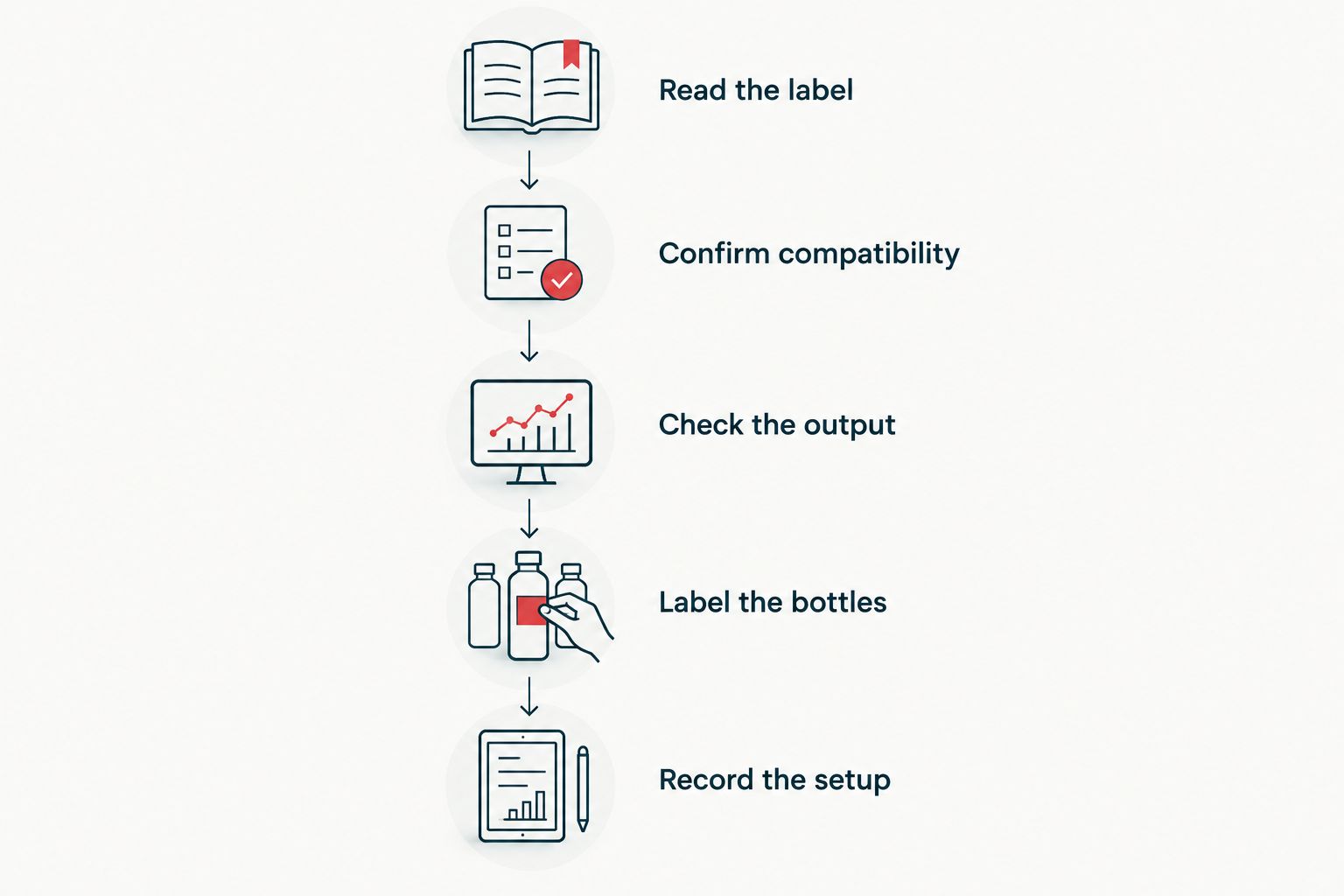
A tidy installation is not a verified installation. Keep the measurement record with the station so the next technician can distinguish an approved configuration from an untested adjustment.
Dilution math: separate the ratio from the bottle size
When instructions explicitly define a ratio as water-to-concentrate, add the ratio parts before calculating a finished batch. These examples demonstrate arithmetic, not recommended dilutions for any named chemical.
For a 10:1 water-to-concentrate mixture totaling 1,100 mL, combine 1,000 mL of water with 100 mL of concentrate. There are eleven total parts, not ten.
For a 4:1 water-to-concentrate mixture totaling 1,000 mL, combine 800 mL of water with 200 mL of concentrate. Measuring 250 mL of concentrate into that finished volume produces a different mixture.
| Explicit water-to-concentrate ratio | Finished batch | Water | Concentrate |
|---|---|---|---|
| 10:1 | 1,100 mL | 1,000 mL | 100 mL |
| 4:1 | 1,000 mL | 800 mL | 200 mL |
If the label expresses concentration per unit of water instead, use that instruction directly. Do not silently convert it into a finished-volume recipe. Follow the prescribed mixing order; arithmetic does not establish safe chemical-handling practice.
How the systems are ranked
This 2026 ranking prioritizes chemical compatibility, verifiable ratio control, water requirements, refill workflow, chemical separation, and maintenance access. Multi-chemical venturi stations take the fixed-shop default because their configuration addresses centralized refilling across several concentrates.
The other categories win different jobs. Single-chemical venturi dispensers suit dedicated refills, proportional pumps suit specified continuous-feed applications, and manual measuring suits mobile or occasional preparation. This is a workflow comparison, not a claim that specific hardware models have been tested against one another.
Which chemical dilution system should you choose?
Choose a multi-chemical wall-mounted venturi station for a fixed shop refilling several compatible concentrates. Confirm the required ratios and water conditions before selecting the model.
Choose a single-chemical venturi dispenser when one cleaner needs its own refill point. Choose a proportional pump only for a defined continuous-feed application. Keep manual measuring available for mobile work and products outside the automatic station’s approved scope.
Detailing World ATL supplies detailing chemicals and mixing supplies. Match those products’ instructions to your proposed station rather than assuming every detailing chemical belongs on a common manifold.
FAQ
What’s the best chemical dilution system for detailing shops?
A multi-chemical wall-mounted venturi station is the default choice for fixed shops repeatedly refilling several compatible concentrates. Confirm each chemical’s prescribed dilution and the dispenser’s operating requirements before choosing a model.
Is a venturi dispenser better than a proportional dosing pump?
A venturi dispenser fits routine bottle or bucket refilling, while a proportional dosing pump fits specified continuous-feed applications. Choose by the job and operating requirements, not by treating one mechanism as universally better.
What dilution system should a mobile detailer use?
A manual measuring station is the practical default for mobile detailing without a dedicated plumbed refill setup. Use suitable measuring tools, identified containers, and each chemical’s written instructions.
Can every detailing chemical go through the same dispenser?
No; dispenser compatibility must be confirmed for each formulation and every wetted component. Separate chemicals when the equipment or chemical instructions require it, and never combine concentrates.
Does a 10:1 dilution mean ten parts water and one part cleaner?
Yes, when the product instructions explicitly define the ratio as water-to-concentrate. That mixture contains eleven total parts; follow the label if it defines the ratio differently.
Can I use a foam cannon as a bottle-filling dilution station?
A foam cannon is application equipment, not a substitute for a bottle-filling station. Its downstream mixing means the reservoir mixture and the solution reaching the vehicle are not interchangeable measurements.
How do I know an automatic dispenser is mixing correctly?
Verify its output using the equipment manufacturer’s commissioning procedure. Record the approved setup and repeat the prescribed checks after changes to chemicals, metering components, tubing, or water conditions.
One last thing
More concentrate is not a correction for an unverified dispenser. If cleaning performance changes, check the mixture, surface suitability, and application instructions before increasing chemical strength. A labeled bottle filled with the wrong mixture is still the wrong mixture.