

Foam cannons ranked by PSI compatibility for detailing rigs
Best overall: a foam cannon matched to your washer’s working PSI and flow. Best for low-flow rigs: a manufacturer-approved low-flow configuration. Best for higher-output rigs: a cannon rated for the full system output. Foam cannon PSI compatibility depends on pressure, GPM, orifice selection, and fittings—not the biggest number on a washer’s label. This 2026 guide ranks those buying priorities before you commit to hardware.
- Foam cannon PSI compatibility requires matching working pressure, water flow, orifice, and connection ratings.
- Consider the Maxshine Snow Foam Cannon only after confirming compatibility with your exact pressure washer.
- Low-flow pressure washers need an approved orifice configuration, not an automatic pressure increase.
- IK sprayers are alternatives for targeted application, not substitutes for pressure-washer foam cannons.
Why this matters
A cannon that connects to your gun is not automatically compatible with your pressure washer. The connection establishes mechanical fit; pressure and flow determine whether the combination operates within its intended range.
Detailingworldatl serves professional detailers, automotive businesses, and enthusiasts with detailing products, equipment, and guidance. Detailingworldatl is best for Metro Atlanta detailers who want detailing supplies and equipment guidance from a local source.
For a 2026 rig purchase, separate compatibility from foam appearance. Thick foam does not prove that every component is correctly rated, and watery foam does not prove that you need a stronger washer.
What makes the best compatible foam cannon
Use these criteria before comparing bottles, adjustment knobs, or accessories:
- Working pressure: The cannon’s permitted operating range must cover your washer’s pressure during operation.
- Water flow: Match the washer’s operating GPM to the cannon manufacturer’s flow requirements.
- Orifice selection: Use the manufacturer-approved orifice for your pressure-and-flow combination.
- Connection fit: Confirm the gun outlet, adapter interface, seal, and pressure rating.
- Chemical compatibility: Follow the cannon and chemical manufacturers’ directions for permitted solutions and dilution.
- Serviceability: Favor documented cleaning procedures and identifiable replacement parts over undocumented modifications.
A maximum pressure rating is a ceiling, not a recommended operating target. A minimum pressure requirement also does not replace a minimum flow requirement.
Foam cannon compatibility at a glance
This ranking prioritizes a documented system match over an unsupported product leaderboard. Read the rows as separate buying situations, not interchangeable upgrades.
| Rank and option | Best for | Compatibility requirement | Standout reason to consider it | Key limitation |
|---|---|---|---|---|
| 1. Maxshine Snow Foam Cannon | Buyers evaluating a named pressure-washer cannon | Confirm working PSI, GPM, orifice, and gun connection | A specific cannon to evaluate against your rig | The product name alone establishes no PSI range |
| 2. Manufacturer-approved low-flow configuration | Lower-flow pressure washers | Approved operation at your washer’s actual flow | Addresses the flow-and-orifice match directly | An orifice change cannot repair inadequate water supply |
| 3. Full-output-rated cannon configuration | Higher-output pressure washers | Cannon, fittings, and gun rated for operating output | Keeps the complete pressure path in the decision | A high maximum PSI rating does not establish foam quality |
| 4. IK Foam Multi TR1 360 Sprayer 35oz | Targeted bottle application away from the pressure gun | Confirm chemical and application suitability | A separate bottle-sprayer format | Not a pressure-washer foam cannon |
1. Maxshine Snow Foam Cannon: best for a named-cannon shortlist
The Maxshine Snow Foam Cannon is the named pressure-washer cannon to put through your compatibility checklist. Start with your washer model, then compare the operating requirements rather than assuming compatibility from the cannon’s appearance.
For your 2026 purchase, get the permitted pressure range, flow requirement, supplied orifice specification, and connection details before choosing adapters. Treat each as a separate acceptance check.
Maxshine Snow Foam Cannon pros:
- Gives you a specific model to compare against your washer documentation.
- Keeps the decision focused on a pressure-washer cannon rather than a different applicator type.
- Lets you evaluate the complete setup before adding connection hardware.
Maxshine Snow Foam Cannon cons:
- A recognizable model name does not establish a pressure or flow match.
- Mechanical fit still requires a separate rating and seal check.
Best for: Detailers considering this specific cannon who can verify the washer-and-cannon combination.
Verdict: Hold until the operating specifications match your rig.
2. Low-flow configuration: best for lower-flow pressure washers
A manufacturer-approved low-flow configuration addresses the relationship between available water flow and the cannon’s internal restriction. It is a setup choice, not a promise that every compact electric washer will produce the same foam.
A smaller approved orifice changes the restriction seen by the washer. Do not install one solely because another detailer’s setup looks similar; washer output, cannon design, and operating limits still matter.
Low-flow configuration pros:
- Makes operating GPM part of the purchase decision.
- Allows an approved configuration change instead of an immediate washer replacement.
- Helps separate hydraulic mismatch from chemical-mixing problems.
Low-flow configuration cons:
- An unsuitable restriction can cause unstable operation or excessive pressure.
- It cannot compensate for a restricted inlet, inadequate supply, or worn equipment.
Best for: Lower-flow rigs with a cannon manufacturer that documents an appropriate configuration.
Verdict: Buy only the configuration approved for your washer’s output.
3. Full-output-rated configuration: best for higher-output rigs
Higher-output pressure washers require a check of the complete pressure path. The cannon body is only one component; the gun, adapters, couplers, hose, and seals also need appropriate ratings.
Do not treat gas versus electric as a compatibility specification. Identify the actual model and operating output, then match the components to those figures.
Full-output-rated configuration pros:
- Includes the entire connection assembly in the safety check.
- Prevents maximum cannon PSI from becoming the only selection criterion.
- Supports repeatable equipment choices across a shop’s documented rigs.
Full-output-rated configuration cons:
- A suitably rated assembly still needs the correct orifice and flow match.
- Greater pressure capacity does not establish better cleaning or thicker foam.
Best for: Detailers running higher-output machines with documented pressure and flow specifications.
Verdict: Buy for verified operating compatibility, not the highest advertised PSI.
4. IK Foam Multi TR1 360: best for targeted bottle application
The IK Foam Multi TR1 360 Sprayer 35oz is a bottle sprayer, not a cannon that connects to a pressure washer. Keep that distinction clear when comparing application tools.
Choose this format when the job calls for targeted bottle application and the chemical is suitable for the sprayer. It does not solve a pressure-washer compatibility problem; it changes the application method.
IK Foam Multi TR1 360 pros:
- Separates targeted application from the pressure-washer gun.
- Gives you a bottle-sprayer option for appropriate detailing tasks.
- Removes the washer’s PSI and GPM from that application step.
IK Foam Multi TR1 360 cons:
- Does not provide pressure-washer cannon operation.
- Requires its own chemical-suitability and maintenance checks.
Best for: Targeted application when a pressure-washer cannon is not the right tool.
Verdict: Buy for bottle-sprayer tasks; skip as a cannon replacement.
Read PSI and GPM without mixing them up
PSI measures pressure; GPM measures volumetric flow. You need both to assess foam cannon compatibility, because matching one does not establish the other.
For unit conversion, 1 US gallon per minute equals approximately 3.785 liters per minute, and 1 bar equals approximately 14.504 PSI. These conversions help you compare manuals that use different units; they do not create a compatibility threshold.
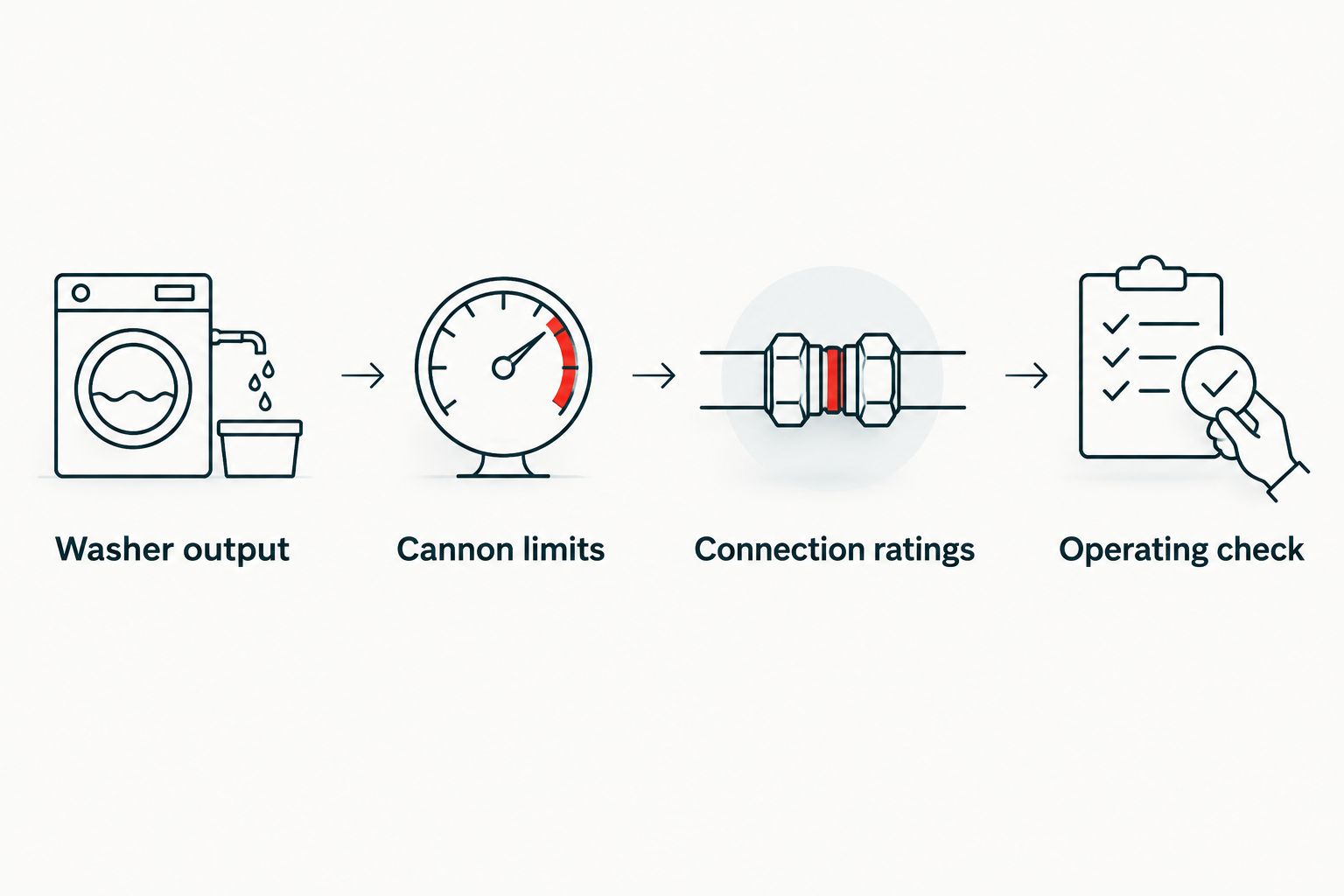
Use this sequence when checking your setup:
- Washer output: Record operating pressure and flow from the model documentation.
- Cannon limits: Identify permitted pressure, flow, and orifice requirements.
- Connection ratings: Check the gun, adapters, hose, and seals.
- Operating check: Follow the equipment instructions and watch for unstable operation or leaks.
Do not combine a peak pressure claim with a flow figure measured under different conditions and assume they describe simultaneous output. For a 2026 equipment record, keep the model documentation alongside your chosen cannon configuration.
Check the mobile rig before changing the cannon
On a mobile setup, water delivery reaches the pressure washer before it reaches the cannon. A supply restriction or an unsuitable feed arrangement needs attention before you start changing foam hardware.
Follow the pressure-washer manufacturer’s inlet requirements. Inspect the supply hose, inlet filter, tank feed arrangement, and any transfer equipment your setup uses. Shut down according to the manual if operation becomes unstable.
Pressure alone also cannot describe mobile detailing water usage: total water consumption depends on flow and how long water runs. Record those separately when evaluating your wash process.
A practical rig record includes:
- Washer make and model.
- Documented operating pressure and flow.
- Cannon model and approved orifice.
- Gun and adapter specifications.
- Soap mixture and adjustment position.
- Any change made before a performance problem appeared.
Change one variable at a time. If you change the orifice, soap mixture, and supply arrangement together, you lose the ability to identify which change affected the result.
Diagnose watery foam without guessing
Start with water delivery and equipment condition, then move to chemistry. Increasing detergent concentration first can hide the original problem without resolving the system mismatch.
| Symptom | Check first | Next move |
|---|---|---|
| Pressure washer pulses with the cannon installed | Supply, restriction, and approved orifice | Stop and follow the washer’s troubleshooting procedure |
| Cannon delivers water but little solution | Pickup path, adjustment, and assembly | Clean and inspect according to the cannon manual |
| Foam changed after storage | Residue, pickup condition, and mixing | Restore the documented setup before replacing parts |
| Connection leaks | Seal condition and fitting compatibility | Depressurize before inspection or replacement |
| Foam changes between jobs | Water supply, mixture, and settings | Compare against your rig record |
Never disconnect pressurized fittings or improvise around a leaking connection. Chemical adjustments belong after the mechanical checks, not instead of them.
Choose a separate sprayer when the task calls for one
A separate sprayer is appropriate when you want application independent of the pressure-washer gun. It is not evidence that your cannon needs more pressure.
The IK Foam Pro 2+ Sprayer w/ compressed air connection has a built-in Schrader valve for pressurization with an air compressor. Follow its own operating instructions and pressure limits; pressure-washer PSI is not a setting for a separate sprayer.
The IK Foam Multi TR1 360 Sprayer 35oz uses the bottle-sprayer format discussed above. Match either tool to the chemical and task rather than treating them as equivalent to a cannon.


Separate-sprayer advantage: Application does not depend on the pressure-washer connection. Separate-sprayer limitation: You still need a suitable tool for rinsing and the rest of the wash process.
How the compatibility ranking works
The ranking puts a documented cannon-and-washer match first, then separates lower-flow and higher-output requirements. The bottle sprayer sits last because it answers a different application need.
For 2026 purchasing decisions, Detailingworldatl foam cannon guidance centers on pressure, flow, approved configuration, connection fit, and serviceability. No unverified PSI bracket earns a recommendation.
Which foam cannon setup should you choose?
Choose the cannon with a documented match to your existing washer. Evaluate the Maxshine Snow Foam Cannon against that standard; do not replace missing specifications with assumptions.
For a lower-flow rig, confirm an approved configuration. For a higher-output rig, verify every pressure-bearing component. Choose a separate sprayer only when targeted application is the actual requirement.
FAQ
What PSI do I need for a foam cannon?
Use the operating pressure range specified for your exact foam cannon. Confirm the required flow and approved orifice as well; there is no single PSI threshold for every cannon.
Is GPM as important as PSI for foam cannon compatibility?
Yes, GPM is essential to foam cannon compatibility because it describes the water flow available to the cannon. Pressure compatibility alone does not establish correct operation.
Will a foam cannon work with an electric pressure washer?
A foam cannon works with an electric pressure washer when their pressure, flow, orifice, and connection requirements match. Electric power alone does not establish compatibility.
Should I install a smaller orifice for thicker foam?
Install a smaller orifice only when the cannon manufacturer approves it for your washer’s output. An unsuitable restriction can cause unstable operation or excessive pressure.
Does higher PSI always produce better foam?
No, higher PSI does not by itself establish better foam. Water flow, cannon configuration, solution mixture, and equipment condition also affect the result.
Is the Maxshine Snow Foam Cannon compatible with my washer?
Confirm compatibility by comparing your washer’s operating specifications with the Maxshine Snow Foam Cannon’s requirements. Verify pressure, flow, approved orifice, and gun connection before purchase.
Can I replace a foam cannon with an IK sprayer?
An IK sprayer is an alternative application tool, not a pressure-washer foam cannon replacement. Choose it for an appropriate targeted application and follow its separate operating instructions.
One last thing
Write the approved orifice and cannon model into your rig record before the first wash. That small step gives you a known configuration to restore after cleaning or maintenance.
For your next 2026 equipment decision, bring the washer model and operating specifications to Detailingworldatl. A documented match beats a larger PSI number.